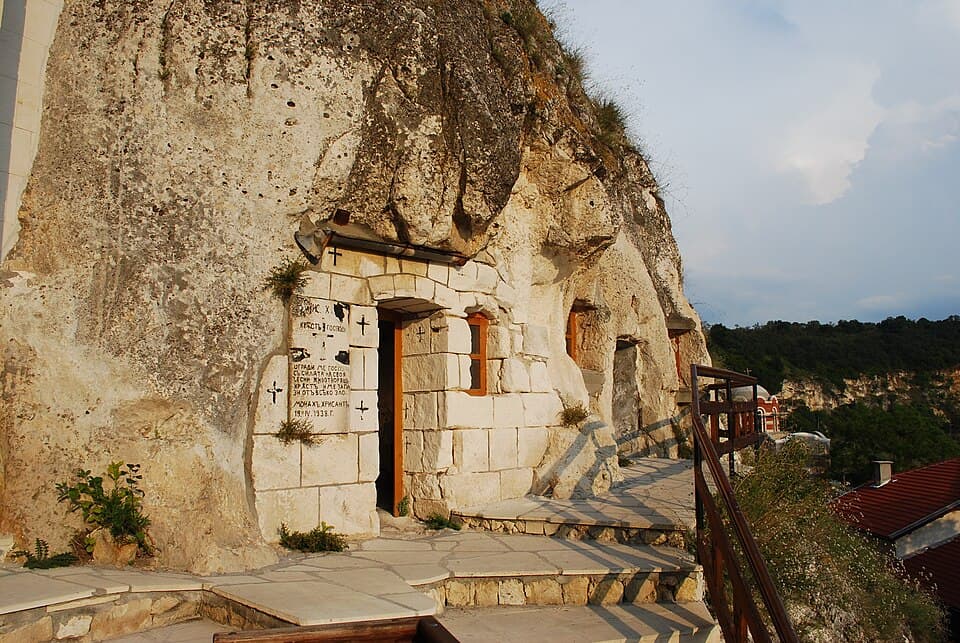
The Basarbovo Monastery of St. Dimitar Basarbovski is one of the most remarkable and serene spiritual sanctuaries in Bulgaria. Tucked into the picturesque valley of the Rusenski Lom River, near the village of Basarbovo, it lies just 10 kilometers from the city of Ruse. The monastery is highly unique as it stands as one of only two active rock-hewn monasteries in Bulgaria today (alongside the Razboishhte Monastery), keeping its gates open to pilgrims and travelers daily. In 1978, the historic site was officially designated as an archaeological monument of culture of local significance.
The origins of this rock-cut retreat date back to the golden era of the Second Bulgarian Empire (12th–14th centuries). However, the earliest written record of the site appears in Ottoman tax registers from 1431, where it was registered under the name "Besaraba" as a fiefdom ("timar") belonging to the Great Voivode Ivanko Basarab (the father-in-law of Bulgarian Tsar Ivan Alexander), after whom the nearby village was named. According to historical legends, the monastery was originally dedicated to the warrior saints Theodore Tyro and Theodore Stratelates, and its primary patron was Queen Theodora Basarab — the first wife of Tsar Ivan Alexander and daughter of the Wallachian ruler.
The most celebrated resident and eternal guardian of the monastery is Saint Dimitar Basarbovski, who spent his life in quiet contemplation, fasting, and prayer within these very cliffs. His legacy was so profound that Father Paisius of Hilendar highlighted his life in his seminal work, Istoriya Slavyanobolgarskaya. During the Russo-Turkish War (1768–1774), the holy relics of the saint were relocated to Bucharest by General Ivan P. Saltykov to protect them from destruction. On July 13, 1774, they were placed in the Metropolitan (now Patriarchal) Cathedral of Saints Constantine and Helen, where they remain highly venerated to this day.
Following a long period of decline, the modern revival of the sanctuary began in 1937, when a dedicated monk named Hrisant settled in the cliffs and initiated restoration works. Today, Basarbovo operates as an active male monastery, welcoming visitors with beautiful cliffside pathways and a peaceful courtyard. In 2016, a major new church dedicated to the Transfiguration of the Lord was officially consecrated and fully adorned with vivid traditional frescoes. The monastery's patronal feast is celebrated annually on October 27, the feast day of Saint Dimitar Basarbovski, drawing numerous pilgrims from both Bulgaria and neighboring Romania.
Ruse region
9.0 km away
Ruse region
9.1 km away

Ruse region
15.8 km away
A travel guide to the Rusenski Lom valley south of Ruse: the UNESCO Ivanovo Rock-Hewn Churches and their medieval frescoes, the Cherven fortress, the working Basarbovo rock monastery, and how to combine all three in one day.
A travel guide to Ruse, Bulgaria's largest Danube port and 'Little Vienna': neo-Baroque architecture, Freedom Square, the Sexaginta Prista Roman fortress, and day trips to the Ivanovo rock churches, Cherven fortress and Basarbovo monastery.
Basarbovo Rock Monastery is located in Ruse, Bulgaria.
Basarbovo Rock Monastery is most easily reached by car. Use the coordinates above to navigate, or open the location in OpenStreetMap or your preferred maps app for turn-by-turn directions. Public transport options vary by region — for remote destinations a rental car gives the most flexibility.
Basarbovo Rock Monastery can be visited year-round. Spring and autumn offer the most pleasant conditions for exploring, with mild temperatures and fewer crowds. Summer is ideal for photography and longer day trips; winter visits are possible but weather can limit access at some sites.
Most natural landmarks in Bulgaria are freely accessible and open year-round, though some sites have entrance fees or require a guide. Wear sturdy footwear and bring water, as the terrain can be uneven. Respect any protective barriers and stay on marked paths to preserve the site.