

Trapezitsa
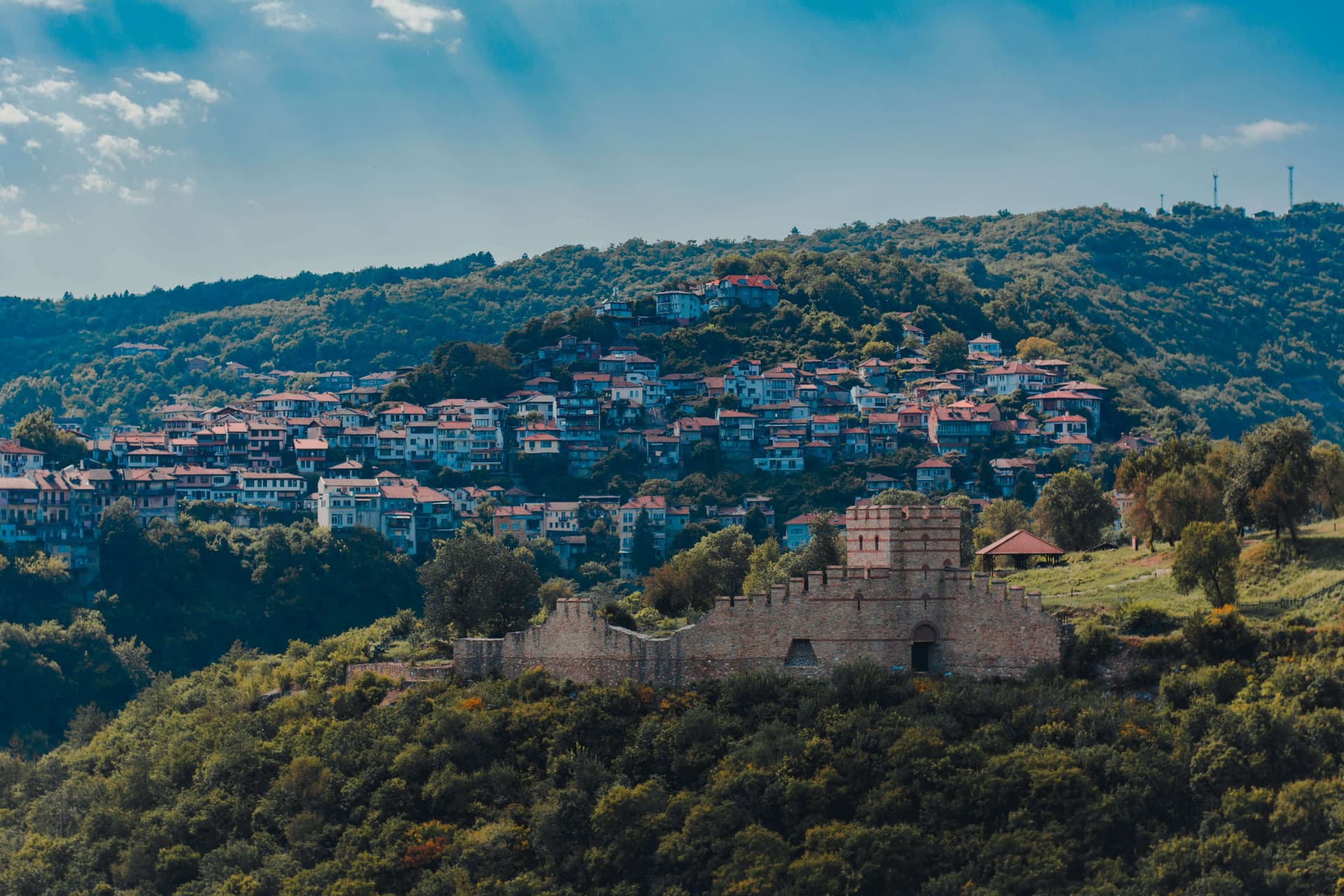
Trapezitsa is a monumental historical hill situated in the city of Veliko Tarnovo, preserving upon its high plateau the excavated ruins of the fortified city or aristocratic quarter of medieval Tarnovgrad. Spanning a total land area of 80 decares, Trapezitsa ranks as the second-most critical and expansive stronghold of the Inner City of the medieval Bulgarian capital. The hill represents a powerful natural rock citadel developed on the right bank of the Yantra River, positioned northwest of the neighboring Tsarevets hill, with the river loop enclosing the plateau symmetrically on three sides.
The Origin of the Hill's Name
Within historical linguistics and regional toponymy, three primary scientific hypotheses outline the etymology of the name Trapezitsa:
- First Hypothesis: The title derives directly from the classic Slavic word trapeza (meaning table or feast), describing the flat, elevated topography of the plateau.
- Second Hypothesis: The name stems from the geometric term trapez (trapezoid), reflecting the actual physical shape of the hill's summit.
- Third Hypothesis (advanced by Professor Boychinov): The name originates from the term trapeziti, denoting the specialized volunteer units of mountain pass guardians. These trapez guards inhabited the hill during the Byzantine rule to execute defensive and scouting operations.
Fortification Engineering and the Four Gateways
During the golden era of the Second Bulgarian Kingdom, high stone curtain walls rose along the steep, vertical rock crests of Trapezitsa, reinforced with battlements, defensive towers, and permanent strategic garrisons. Two massive transverse curtain walls descended perpendicularly down the hillsides directly to the riverbed to seal off the valley from enemy advances: one wall anchored the eastern slope next to the restored Saint Demetrius of Thessalonica Church, while the second cut down the western incline toward the modern railway bridge.
The interior of the aristocratic citadel was accessible via four separate gateways:
- The Main Southern Gate: Situated at the absolute southern rocky tip of the hill, it was logistically linked with the adjacent Tsarevets fortress by a heavy wooden bridge spanning the Yantra River, positioned directly opposite the royal Holy Forty Martyrs Church. A wide cobblestone highway, carved deeply into the solid rock mass, climbed to this portal; visible remnants of this road and the southern gateway remain perfectly conserved and accessible for travelers today.
Christian Art and Architecture of the Medieval Churches
During systematic archaeological excavations conducted on the hill, the foundations of 17 medieval churches were uncovered and researched. The surviving artistic fragments discovered along the masonry walls prove that these shrines were lavishly decorated with colorful frescoes, multi-colored floor mosaics, and glazed pottery elements. The materials excavated during the early operations were not immediately published in academic prints, but surviving official administrative correspondence confirms that priceless monuments from the era of the medieval Bulgarian state were unearthed: gold and silver crosses, royal and noble coins, fine necklaces, signet rings, earrings, and luxury domestic ceramics.
The churches of Trapezitsa are distinguished by their incredibly rich exterior architectural ornamentation, characteristic of the Tarnovo Artistic School: pilasters, decorative niches, blind arches, colored ceramic tiles, and multi-colored glazed clay bowls of circular or four-leaf designs covered in brilliant green or yellow glazes, arranged in concentric arched rows along the facades. The numerous and beautifully decorated small churches prove conclusively that the fortified urban estates of the wealthiest Bulgarian boyars and the high Orthodox clergy were centered atop Trapezitsa.
Church Number 8 and the Cult of Saint John of Rila
The largest structure in terms of architectural dimensions is Church number 8, celebrated in Bulgarian history as the Church of Saint John of Rila (Ivan Rilski). Adjacent to its thick masonry walls, archaeologists exposed the foundations of massive stone buildings, which historians identify as a large monastic complex. Invaluable fragments of medieval fresco layers are conserved along the interior walls of the temple.
Historical chronicles document that in 1195, the celebrated Bulgarian Tsar Ivan Asen I triumphantly translated the holy relics of the celestial patron of Bulgaria, Saint John of Rila, from the city of Sredets (modern Sofia) to the capital of Tarnovgrad. The holy remains were deposited with supreme state honors inside this custom-built church atop the Trapezitsa hill. A specialized supplementary chamber built onto the southern facade of Church number 8 is recognized by scholars as an official reliquary vault. The relics of the Rila hermit were preserved and venerated in Veliko Tarnovo for nearly three centuries, until 1469, when a major religious procession carried the saint back to the Rila Monastery.
Modern Expansion, Conservation, and Site Restoration
During the contemporary period, between 2008 and 2015, extensive new archaeological excavations were launched on Trapezitsa, engaging leading Bulgarian scientists. Within this framework, a comprehensive architectural restoration of the Southern Battle Tower was finalized, modern tourist infrastructure was developed - including a specialized funicular railway providing smooth access for travelers - and high-precision partial reconstructions of the most valuable medieval churches were completed.
Chronology of Archaeological Discoveries Through the Centuries
Excavations and Restrictions in the 19th Century
The earliest scientific interest in researching the architectural ruins atop the plateau emerged during the mid-19th century. In 1856, however, the Ottoman authorities issued an official imperial decree prohibiting any excavations on Trapezitsa. The first actual and serious archaeological soundings were carried out immediately after the Liberation, in 1878, under the guidance of Professor Marin Drinov and Dr. Vasil Beron. In 1884, the operations were extended by Vasil Beron under the auspices of the newly established Tarnovo Archaeological Society. The most detailed, systematic, and cartographic surveys of the late century were performed by the prominent Czech scholar Karel Skorpil. Capitalizing on the well-preserved above-ground outlines of curtain walls, towers, gateways, and shrines visible at that time, he produced the first comprehensive topographical and structural plan of Trapezitsa, published officially in 1910 concurrently with his plan of Tsarevets.
Surveys During the First Half of the 20th Century
Between 1900 and 1901, the French researcher Georges Seure conducted excavations on the hill, unearthing the foundations of 14 additional medieval churches, complementing the three identified prior. The personal field notes written by Seure, however, were extremely brief and failed to provide thorough scientific data regarding the excavated artifacts. A detailed structural layout of the ruins exposed by the French scholar was drafted by engineers representing the Tarnovo Technical District, P. Abadjiev and R. Mihaylov. Between 1903 and 1904, the prominent painter and conservator V. Dimov, commissioned by the National Museum in Sofia, executed the first comprehensive scientific catalog of the churches and compiled full graphic documentation of the surviving medieval paintings, accompanied by precise oil copies on canvas preserved in state archives.
7-day forecast
Weather data from MET NorwayNearby Places

More to explore

Read more in our travel guides
Frequently asked questions
Where is Trapezitsa located?
Trapezitsa is located in Veliko Tarnovo, Bulgaria.
How do I get to Trapezitsa?
Trapezitsa is most easily reached by car. Use the coordinates above to navigate, or open the location in OpenStreetMap or your preferred maps app for turn-by-turn directions. Public transport options vary by region — for remote destinations a rental car gives the most flexibility.
What is the best time to visit Trapezitsa?
Trapezitsa can be visited year-round. Spring and autumn offer the most pleasant conditions for exploring, with mild temperatures and fewer crowds. Summer is ideal for photography and longer day trips; winter visits are possible but weather can limit access at some sites.
What should I know before visiting Trapezitsa?
Most natural landmarks in Bulgaria are freely accessible and open year-round, though some sites have entrance fees or require a guide. Wear sturdy footwear and bring water, as the terrain can be uneven. Respect any protective barriers and stay on marked paths to preserve the site.