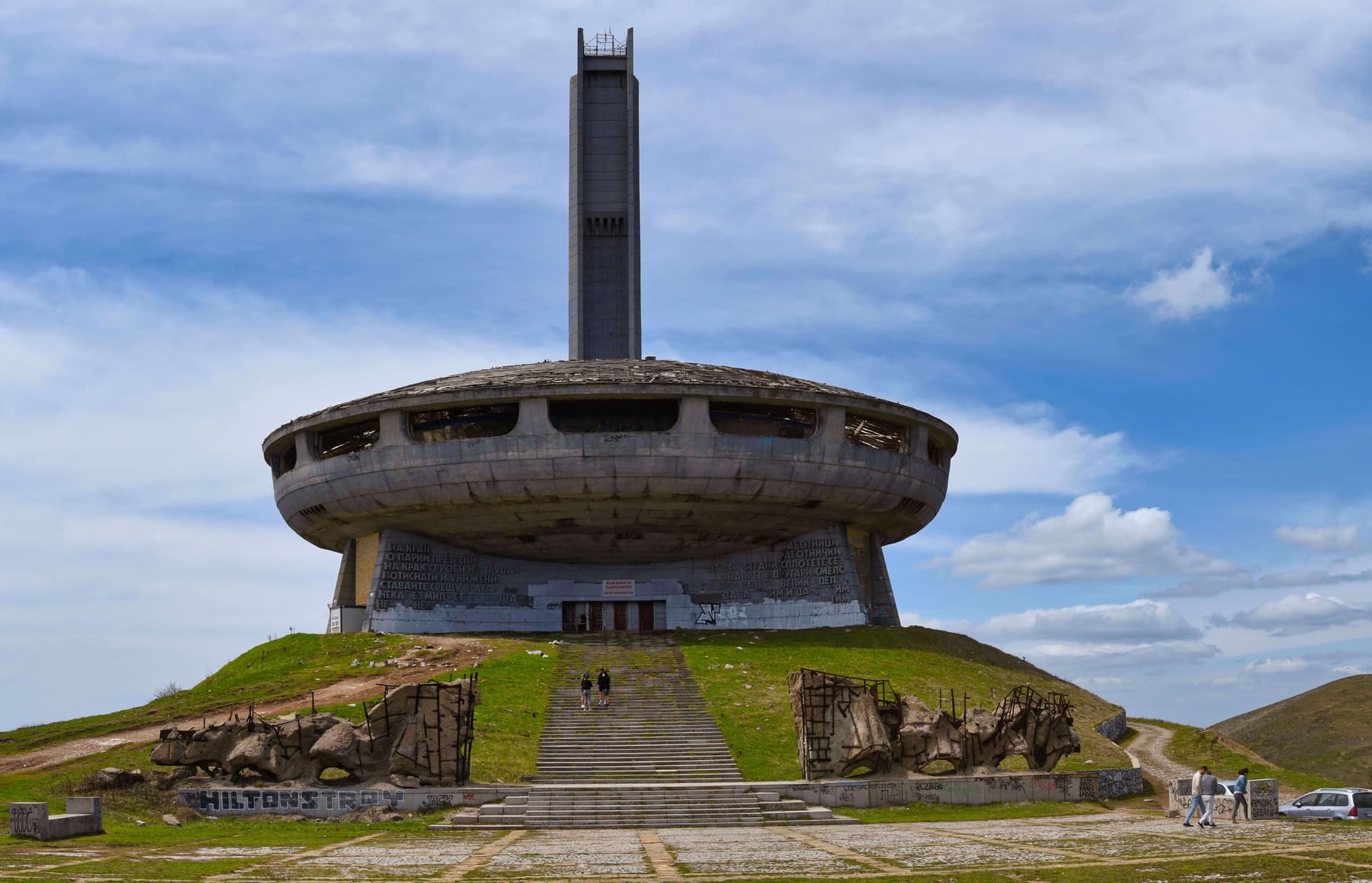
The Buzludzha Monument, whose official state nomenclature is the House-Monument of the Bulgarian Communist Party, stands as the largest, most brutalist, and widely renowned ideological structure engineered during the communist regime across the Republic of Bulgaria. This colossal mountain asset forms an inseparable component of the Shipka - Buzludzha National Park-Museum network. The district commands a high legal status, proclaimed an official historical and architectural reserve inside the State Gazette issue number 97 in 1978.
The monument was erected in 1981 atop the Balkan mountain crest of Hadzhi Dimitar, which within Bulgarian culture and folklore is more widely designated under its old traditional title of Mount Buzludzha, adjusted administratively in 1942. The selection of this specific location is deeply symbolic, chosen to commemorate the assembly of the historic Buzludzha Congress on the same mountain summit back in the year 1891. During that congress, coordinated under the leadership of Dimitar Blagoev, the Bulgarian Social Democratic Party was established, recognized within modern history as the direct predecessor to the Bulgarian Communist Party and the contemporary Bulgarian Socialist Party. Consequently, Mount Buzludzha and the structure standing at its summit held the sovereign status of an official party sanctuary for Bulgarian communists until the political transformations rolling in 10 November 1989.
The monument atop Mount Hadzhi Dimitar positions immediate to the expansive mountain locality of Vatro Pole, more widely mapped as Uzana, which officially structures as the verified geographical center of the nation. Integrated inside the concept design of the monument was the placement of two colossal illuminated red pentagonal stars possessing a cumulative electrical power capacity of 150 kilowatts. Throughout that specific era, state ideological propaganda widely disseminated the legendary assertion that under completely clear night skies, the potent crimson light radiating from the southern star could be detected with the naked eye from the shores of the Aegean Sea across Western Thrace.
From geographical, physical, and geodetic perspectives, this assertion is entirely inaccurate and scientifically impossible. While panoramic visibility facing north toward the plains and the Danube River is theoretically possible under pristine meteorological conditions, line-of-sight visibility facing south toward the Aegean basin is completely obstructed by the natural curvature of the Earth coupled with the massive, high mountainous barrier of the Rhodope Massif.
A developed transport infrastructure has been engineered leading directly to the base of the monument, featuring asphalted automobile access routing from two primary vectors - straight from the historic Shipka Pass and from the primary national highway connecting Stara Zagora and Ruse in the mountain segment tracking immediate to the town of Kazanlak. Positioned at the main highway exit pointing toward the peak is a tall full-length monument honoring the socialist philosopher Dimitar Blagoev.
The official state decree authorizing the design and construction of the BCP House-Monument was ratified by the Secretariat of the Central Committee of the Bulgarian Communist Party on March 11, 1971. Genuine construction operations launched upon the mountain summit in 1974, funded entirely via a massive nationwide accumulation of public donations, with the total financial parameters of the infrastructure project reaching 14 186 000 Bulgarian leva of that era.
Engaged across the demanding construction operations on the peak were the formations of the state Construction Troops, professional craftsmen, and thousands of volunteer student brigades coordinated under the Dimitrov Komsomol Youth Union. Operating as the primary commander and head coordinator of this grand national building site was General Delcho Delchev, chief of the prominent Stara Zagora construction division. To service the lifting requirements of the project, two heavy-duty tower cranes were deployed upon the peak in 1975, with one specialized unit imported from Liebherr to erect the high vertical pylon, and a secondary unit dedicated to building the round main hull, featuring an operational boom length measuring 40 meters. The monument was officially inaugurated to host public assemblies on August 23, 1981, personally by the long-standing party and state leader Todor Zhivkov.
In architectural terms, the distinct silhouette defining the monument is most frequently interpreted by experts as a ceremonial sacrificial platter accompanied by a soaring vertical column, symbolizing a unfurled communist banner paired with a triumphal laurel wreath honoring the party. The architectural blueprint was compiled by a major planning collective directed personally by the prominent architect Georgi Stoilov, while the complex structural engineering systems were calculated under the scientific guidance of Professor Engineer Dobromir Kolarov. The exterior concrete shell displays a pronounced visual affinity to the modern architecture of the Olympic Stadium in Montreal, Canada, as well as to a futuristic ecclesiastical facility designed around 1955 by the legendary master Frank Lloyd Wright for the Greek Orthodox Church in Wisconsin, United States.
The House-Monument incorporates the following primary components:
Following the onset of radical political transitions across Bulgaria post-10 November 1989, maintenance operations ceased entirely and the physical structural condition of the monument degraded drastically. In 1992, the monument was officially nationalized by virtue of the special Law on the Nationalization of BCP Property, with the entry portals subsequently sealed to block access. During the governance of Prime Minister Ivan Kostov, state armed security forces were completely withdrawn from the location, abandoning the asset to comprehensive and irreversible vandalism, looting, and scrap-metal scavenging.
This wave of uncontrolled vandalism triggered severe consequences for the structural integrity:
Despite the severe physical degradation gripping both the interior and exterior surfaces, the Buzludzha Monument achieved tremendous international fame among global photographers, architects, and urban explorers. The asset was officially integrated within the prestigious world registry tracking The Most Beautiful Abandoned Places in the World under number 25, while in 2013, a matching classification compiled by leading international travel platforms awarded it the absolute first place globally, transforming its concrete ruins into a world-famous epicenter for alternative urbex tourism.
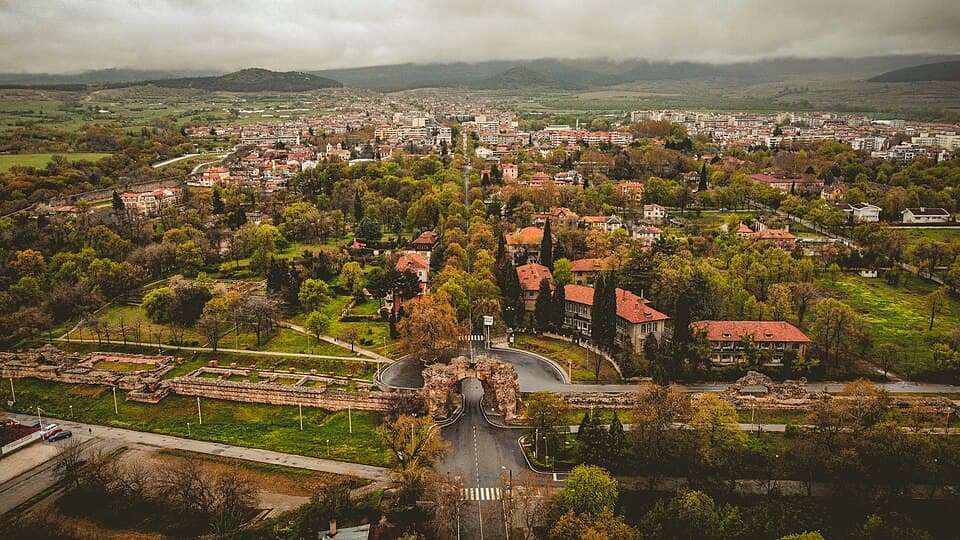
Hisarya or Pavel Banya for a spa weekend: Roman walls and mineral fountains, or a five-star spa base in the Rose Valley — tickets, parking, prices and which to pick.
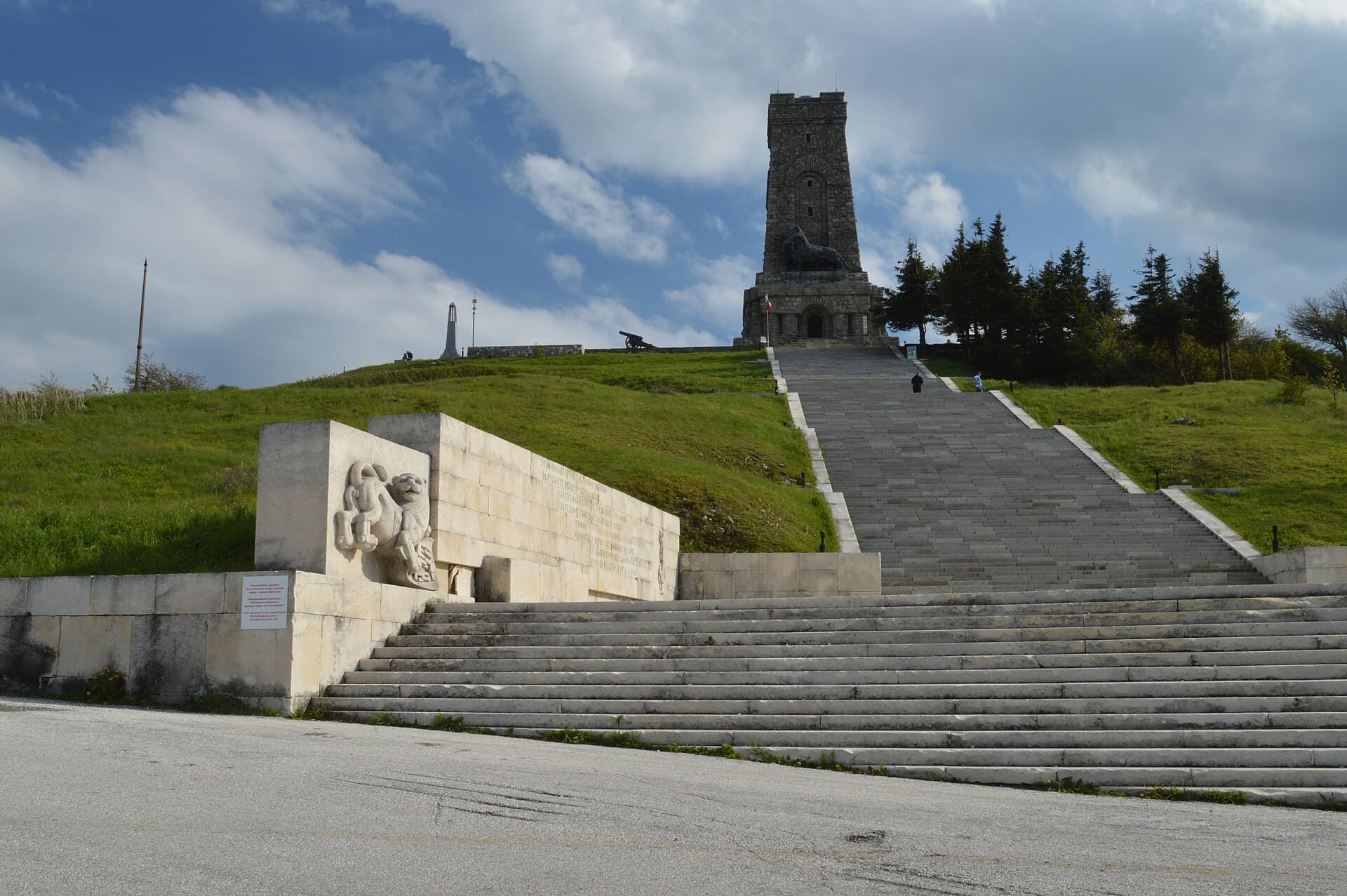
A complete guide to crossing the Shipka Pass: Climb the 890 steps to the Monument of Freedom, visit the gold-domed Shipka Memorial Church, and explore nearby Buzludzha.

The best day trips from Plovdiv: Bachkovo Monastery, Asen's Fortress, the Rose Valley, Buzludzha, Koprivshtitsa and more — with distances and how to go.
Buzludzha Monument is located in Stara Zagora, Bulgaria.
Buzludzha Monument is most easily reached by car. Use the coordinates above to navigate, or open the location in OpenStreetMap or your preferred maps app for turn-by-turn directions. Public transport options vary by region — for remote destinations a rental car gives the most flexibility.
Buzludzha Monument can be visited year-round. Spring and autumn offer the most pleasant conditions for exploring, with mild temperatures and fewer crowds. Summer is ideal for photography and longer day trips; winter visits are possible but weather can limit access at some sites.
Most natural landmarks in Bulgaria are freely accessible and open year-round, though some sites have entrance fees or require a guide. Wear sturdy footwear and bring water, as the terrain can be uneven. Respect any protective barriers and stay on marked paths to preserve the site.