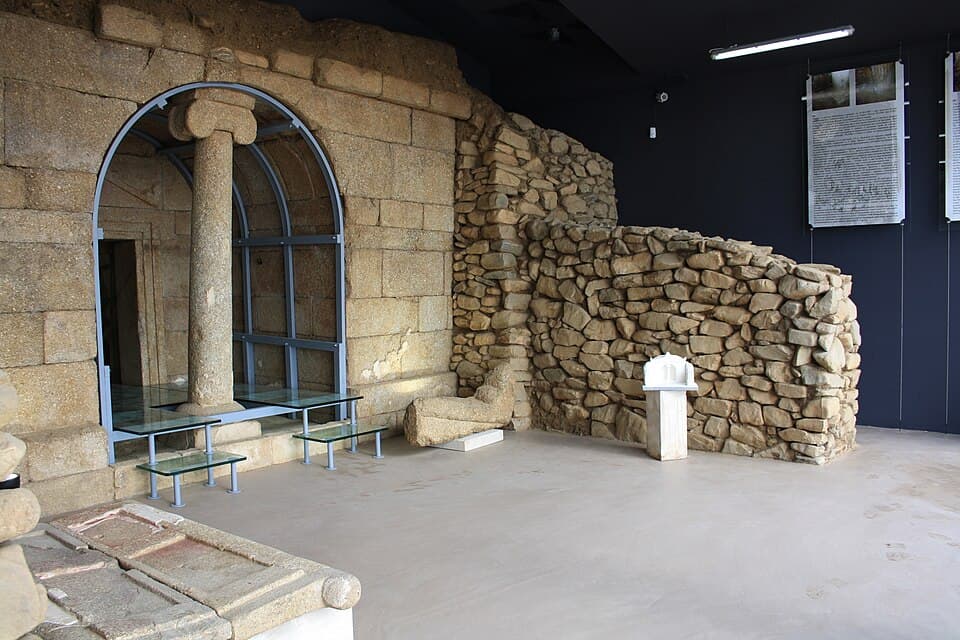
The Thracian Tomb of Kazanlak was discovered accidentally on April 19, 1944, by soldiers digging an air-raid shelter. Built directly at the level of the surrounding terrain, it is oriented along a north-south axis with its entrance facing south. The architectural complex consists of three main sections: an entrance corridor (dromos), a rectangular antechamber, and a round burial chamber topped with a brick dome.
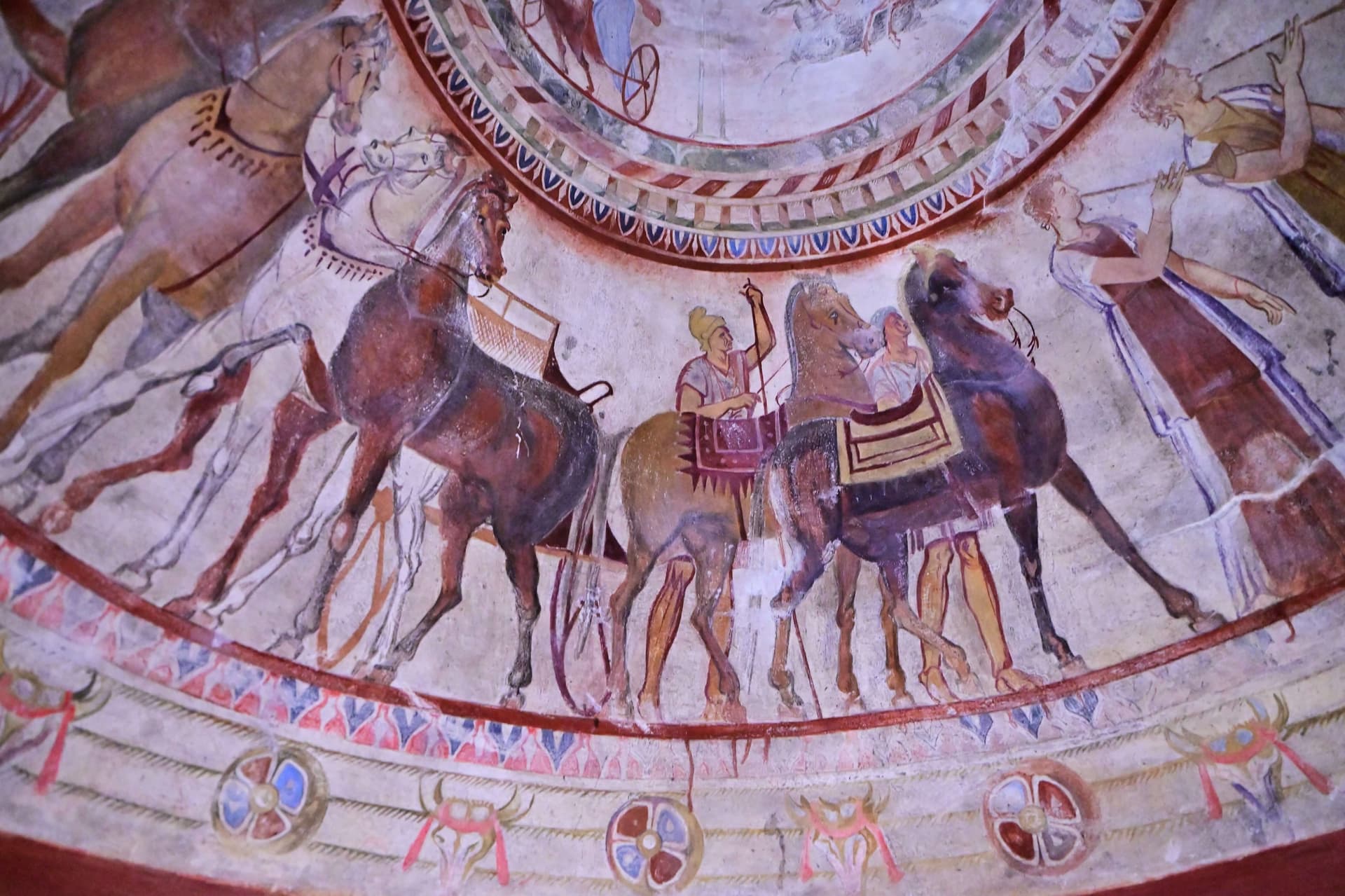
The corridor is constructed from unhewn stones and measures 1.84 by 2.60 meters. Its walls gradually decrease in height from the facade moving southward, and they were originally sealed with a 0.7-meter-high retaining wall. Both chambers are built of bricks bound with high-quality mortar. Their walls and floors are covered with a three-layer plaster, which serves as the canvas for world-famous murals executed in tempera and fresco techniques. To protect the invaluable original paintings, a precise and detailed copy of the Kazanlak Tomb has been built adjacent to it for tourists, replicating every single detail of the ancient masterpiece.
Architecture and Unique Murals of the Chambers
The antechamber features a rectangular layout measuring 1.12 by 1.96 meters and a height of 2.25 meters, topped with a gabled vault. The wall plaster is masterfully divided according to the classical Ionic order into several colored bands of white, black, and red, above which two friezes are displayed. The first frieze rests on rows of pearl beads, Ionic and Lesbian cyma. Set against a deep black background, a central palmette design unfolds, from which symmetrical tendrils with light green leaves and light red flowers emerge.
The murals in this chamber finish with a figurative frieze showcasing dynamic military battle scenes. The center of each scene features a pair of clashing warriors, joined from both sides by armed infantrymen and galloping horsemen. They wear short tunics (chitons) and low shoes, with red and blue cloaks (chlamydes) billowing from their shoulders. Their weaponry includes various helmets, pairs of short spears, and long curved swords known as makhairas, while they defend themselves with large shields. These scenes are believed to represent real-life events from the deceased rulers life or funeral games held in his honor.
A rectangular doorway framed by 4 massive stone blocks leads into the main vaulted chamber. On the inner side of this entrance, a single-winged metal door once stood. The circular room has a diameter of 2.65 meters, a height of 3.25 meters, and a unique beehive-bell shape, sealed at the top with a capstone. The lower half of the walls features alternating vertical panels of black, white, and red. The architrave displays twelve four-leafed rosettes alternating with twelve bull heads (bucrania) decorated with festive garlands. Above this rests a Lesbian cyma, supporting the main frieze that features the world-renowned scene of heroization.
The central group of the main frieze features three prominent figures:
Historians interpret this scene as a funeral feast. On both sides of this central group, a ceremonial procession unfolds. Behind the woman in the peplos walks a young man carrying a jug and a cup, followed by two female musicians in long tunics and two warriors leading saddled horses. To the left of the Thracian noblewoman, a maid carrying a small gabled jewelry box and a rectangular chest is depicted, followed by a second woman holding a light blue cloak. The procession concludes with a young man leading four horses harnessed to a traditional Thracian chariot. At the very top of the dome, a fast-paced chariot race with two-horse chariots (bigae) is painted, while the capstone itself is adorned with an eight-leafed rosette.
Although the burial chamber was plundered in antiquity, archaeological excavations uncovered significant insights into Thracian culture. Inside the circular chamber, researchers discovered:
Inside the antechamber, archaeologists found a clay oinochoe (wine jug) and the bones of a ritualistic burial horse, buried alongside its master. Outside the tomb structure, within the earthen mound, two ritual hearths with traces of sacrifices were uncovered, containing animal bones, two clay askoi, a silver jug, and two large storage jars (pithoi).
The architectural layout, the advanced brickwork, the artistic style, and the painting techniques date the Thracian Tomb of Kazanlak to the first half of the 3rd century BC. It remains a key focus of study for prominent Bulgarian archaeologists and historians.
The absolute harmony between architecture and painting, combined with the unique style and incredible skill of the ancient artist, makes the Kazanlak Tomb one of the ultimate masterpieces of Thracian art and ancient cultural heritage. Consequently, in 1979, the Thracian Tomb of Kazanlak was officially inscribed as a monument of global significance under the protection of UNESCO, drawing thousands of Bulgarian and international travelers to the city of Kazanlak.
Thracian Tomb of Kazanlak (Replica) is located in Stara Zagora, Bulgaria.
Thracian Tomb of Kazanlak (Replica) is most easily reached by car. Use the coordinates above to navigate, or open the location in OpenStreetMap or your preferred maps app for turn-by-turn directions. Public transport options vary by region — for remote destinations a rental car gives the most flexibility.
Thracian Tomb of Kazanlak (Replica) can be visited year-round. Spring and autumn offer the most pleasant conditions for exploring, with mild temperatures and fewer crowds. Summer is ideal for photography and longer day trips; winter visits are possible but weather can limit access at some sites.
Most natural landmarks in Bulgaria are freely accessible and open year-round, though some sites have entrance fees or require a guide. Wear sturdy footwear and bring water, as the terrain can be uneven. Respect any protective barriers and stay on marked paths to preserve the site.