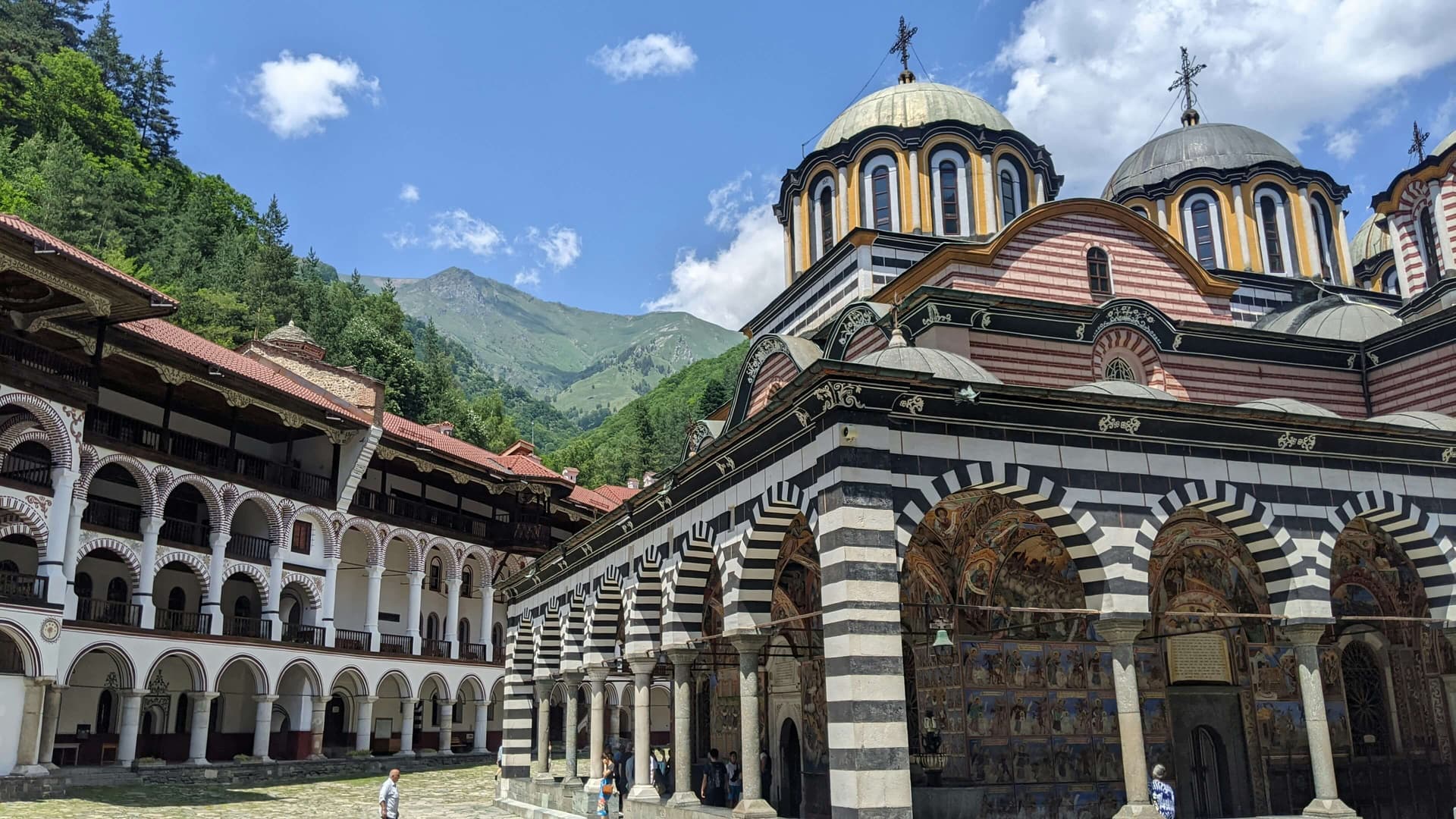
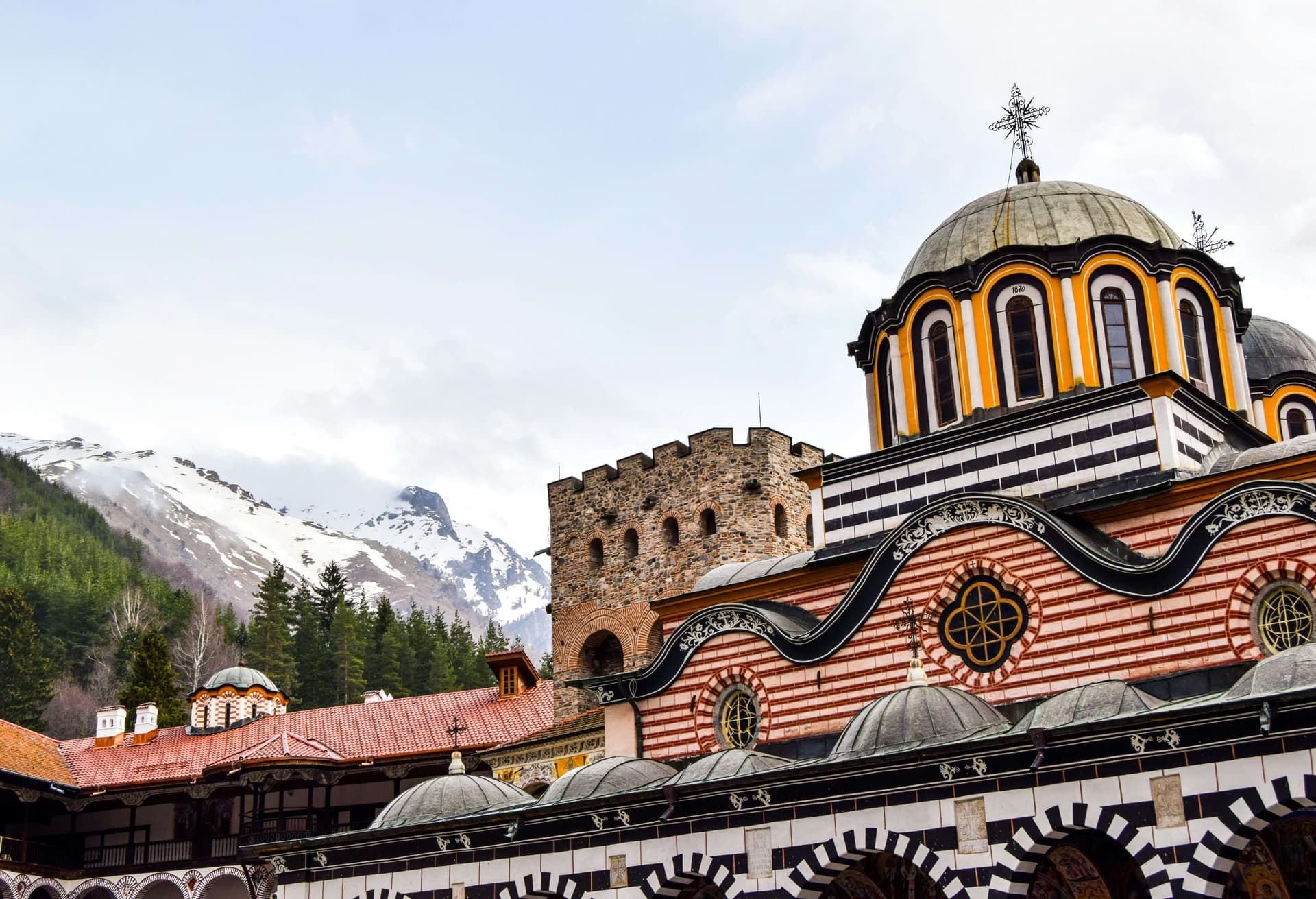
The Rila Monastery "St. Ivan of Rila" is the largest, most significant, and majestic stavropegic monastery of the Bulgarian Orthodox Church. Nestled in the heart of the Rila Mountains, it stands as the ultimate symbol of Bulgarian national identity, spirituality, and culture. Due to its exceptional architectural, historical, and artistic value, the monastic complex is inscribed on the UNESCO World Cultural and Natural Heritage List. The cloister represents an incredible assembly of medieval fortification, Bulgarian National Revival architecture, and the highest achievements of Eastern Orthodox art.
Geographical Position, Parameters, and Architectural Features
- Location: Situated in Southwestern Bulgaria, Kyustendil Province, Rila Municipality, along the upper reaches of the rushing Rilska River, near the scenic village of Pastra.
- Complex Scope: The monastic ensemble covers a total territory of 8,800 square meters, of which 5,500 square meters constitute the built-up area. The residential wings surround a spacious inner cobblestone courtyard shaped like an irregular pentagon.
- The Floor Paradox: The main residential wings rise across 4 and 5 floors, but from the outside, only 4 are visible. This unique structural feature was dictated by strict regulations imposed by the Ottoman authorities in 1834 during the general reconstruction of the complex. The spacious ground floor houses the extensive Main History Museum.
Centuries of History and National Significance
- 10th Century Foundation: The holy retreat was founded in the first half of the 10th century by the great Bulgarian hermit and monk St. Ivan of Rila the Wonderworker. Since its inception, the monastery grew into the primary literary, educational, and cultural center across the Bulgarian lands.
- The Rila Charter of Tsar Ivan Shishman: On September 21, 1378, the last ruler of the Tarnovo Kingdom, Tsar Ivan Shishman, issued the famous Rila Charter. Sealed with a golden stamp, this historic document granted the monastery feudal ownership over 20 large villages and their territories.
- Return of the Holy Relics (1469): Following a long absence, the earthly remains of St. Ivan of Rila were ceremonially transferred back from Tarnovo to the Rila Monastery in 1469, achieved through the critical diplomatic support of the Christian Sultana Mara Brankovich.
- A Sanctuary for Revolutionaries: During the National Revival era, the prominent scholar Neofit Rilski conducted extensive educational work here, establishing a modern cell school. In subsequent decades, the monastery cells provided a safe haven for legendary Bulgarian revolutionaries and freedom fighters, including Vasil Levski, Ilyo Voyvoda, Gotse Delchev, and Peyo Yavorov.
- The Rila Congress of VMORO (1905): In October 1905, the monastery hosted the historic general congress of the Internal Macedonian-Adrianople Revolutionary Organization (VMORO) for an entire month. Chaired by Dame Gruev, it brought together iconic leaders such as Yane Sandanski, Hristo Chernopeev, and Boris Sarafov.
Disasters, Fires, and Reconstruction
Due to its isolated wilderness location, the monastery frequently fell victim to bandit raids and pillaging by the Ottoman army (notably in 1778, 1818, and 1821).
- The Fire of 1778: The complex was burned to the ground, leaving only the stone defensive tower and the central courtyard church intact. It was rebuilt in 1784 by the architect Aleksi Rilets, who later designed and constructed the eastern, northern, and western residential wings.
- The Fire of 1833: Another massive accidental fire devastated the residential wings. Their full restoration was completed in record time by Aleksi Rilets under the guidance of the energetic Abbot Joseph the Builder.
Key Monuments Within the Monastic Complex
- Hrelyo’s Tower: The oldest fully preserved structure within the complex, erected in 1335 by the local feudal lord Protosebastos Hrelyo Dragovol. It served as a defensive stronghold in case of siege. Its topmost floor houses the Chapel of the Holy Transfiguration, featuring invaluable frescoes dating back to the 1400s.
- The Main Church of the Dormition of the Mother of God: The main monastic temple (catholicon), built between 1835 and 1837 by master builder Pavel Ivanovich over the foundations of the older Hrelyo Church. The temple is an Mt. Athos-style five-domed cross-in-square basilica featuring two side chapels dedicated to St. Nicholas and St. Ivan of Rila. The elegant external arcaded gallery serves as an open narthex. The wall paintings are the work of National Revival masters Dimitar Hristov Zograf and Zahari Zograf, while the woodcarven iconostasis was crafted by Atanas Teladur and Petar Garka.
- The Chapel of the Nativity of Christ: The largest of the eight inner chapels. Projected in the second half of the 20th century, its construction was halted by the communist authoritarian regime, which turned the space into a movie theater after expelling the monks. It was fully restored under Abbot Bishop Evlogiy and has operated as a winter chapel since 2009, housing the miraculous icon of the Mother of God Otrada, Uteshenie from Zograf Monastery.
- The Presentation of the Blessed Virgin Cemetery Church: Located south of the main complex, this 18th-century structure is a two-story church-ossuary. The lower level stores the bones of deceased monks, while the upper church was adorned with frescoes in 1795 through funding by Metropolitan Philotheus of Samokov.
Hermitages and Outlying Monastic Metochions
- The Old Hermitage and Cave: Located 5 km east of the monastery. This site features the Church of the Dormition of St. Ivan of Rila, rebuilt from its foundations in 1820 over the saint's original grave, situated right next to the natural rock cave where the hermit spent his final years.
- The New Hermitage (St. Luke Skete): Comprises the two-story Church of St. Luke (late 18th century), painted by Toma Vishanov Molera and Samokov masters, next to which Neofit Rilski later established a school. On a higher natural terrace sits the Church of the Protection of the Mother of God (Pokrov Bogorodichen, 1805) with frescoes from the Bansko Art School.
- The St. Theodosius of Tarnovo Hermitage: Built of dressed stone 1.5 km from the monastery in 1956 by monk Theodosius Rilets and painted by the Russian artist Nikolay Shelehov.
- Orlitsa Metochion: Situated on the right bank of the Rilska River, 18 km before reaching the main monastery. Founded in the mid-15th century, the holy procession carrying the saint's relics spent the night here in 1469. It features the small single-nave Church of St. St. Peter and Paul (1478), repainted in 1863 by Nikola Obrazopisov.
- Pchelino Metochion: Located 4 km southwest of the monastery complex. It includes rural structures and the single-nave Church of the Dormition of the Mother of God (1780s). Its frescoes were painted by the Bansko master Dimitar Molerov (1834), featuring a magnificent multi-figure depiction of the Last Judgment covering the western wall.
Liturgical Rule, Traditions, and Sacred Relics
- Daily Liturgies: The monastery follows a strict daily liturgical schedule. Matins and Holy Liturgy begin at 06:30 AM (08:00 AM on Sundays and major feast days), followed by Vespers at 05:00 PM. During services, pilgrims line up to venerate the relics of St. Ivan of Rila. On the three major feast days dedicated to the saint, all-night vigils are conducted according to Mt. Athos traditions.
- The Miraculous Icon of the Holy Mother of God Osenovitsa: One of the greatest spiritual relics of Bulgaria, dating back to the 12th century. Belonging to the Hodegetria (Guide) type, it features the embedded holy relics of 32 Christian saints (including Saint Luke the Evangelist and Saint Lazarus). The icon is brought out for public religious processions twice a year—on Bright Friday and on August 1st.