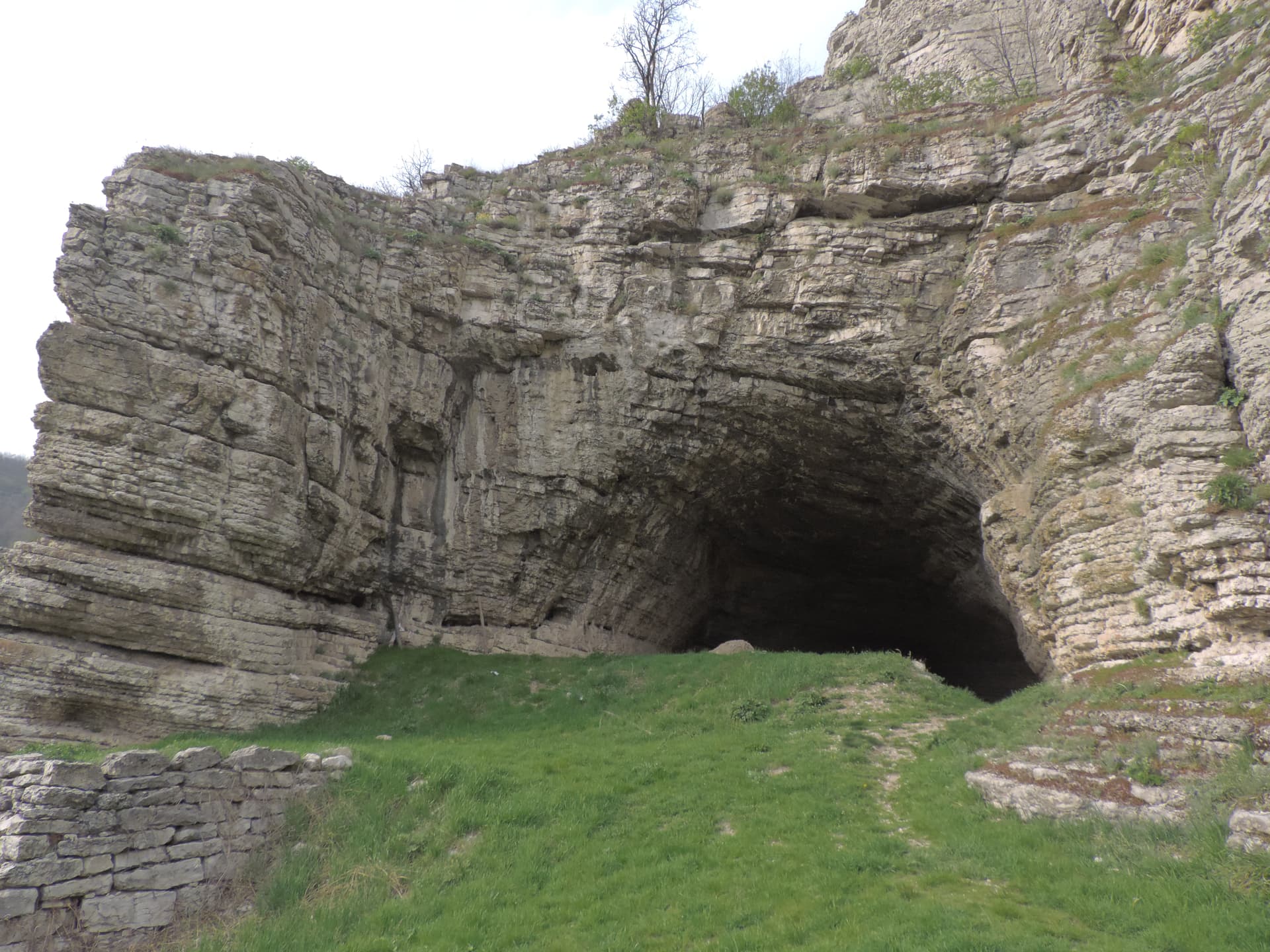
Kozarnika Cave, also widely known among scientific circles and locals as Kozarska Cave or Zhivanina Dupka, is one of the most significant archaeological and paleontological sites not only in Bulgaria but globally. Located in the picturesque landscape of the Western Balkan Mountains within the Dimovo Municipality (Vidin Province), this site is an essential destination for historical research. While the cave itself is relatively short, with a total gallery length of 210 meters, its true value lies in the ancient earthen layers that shield the traces of the earliest human history. Situated in close proximity is another popular natural landmark - the electrified and visitor-friendly Venetsa Cave.
Kozarnika Cave is nestled into prominent limestone cliffs, roughly 2.2 kilometers west-southwest of the village of Gara Oreshets, right alongside the main road leading toward the town of Belogradchik.
Since 1996, the cave has been the site of continuous and extensive archaeological excavations. These are organized jointly by the National Archaeological Institute with Museum at the Bulgarian Academy of Sciences (BAS) in Sofia and the Institute of Geology and Prehistory of the Quaternary in Bordeaux, France. The scientific expeditions are led by prominent researchers Nikolay Sirakov and Jean-Luc Guadelli. The excavations have uncovered a unique Late Paleolithic culture dating from 37 000 to 34 000 BC. The findings here differ significantly from those in other famous Bulgarian caves, such as Temnata Dupka and Bacho Kiro, showing astonishing similarities with cultures that spread across Western Europe several millennia later.
While the cave was actively occupied during the Middle Paleolithic, its deepest, lowest Early Paleolithic layers have triggered international acclaim and scientific sensation.
Numerous fossilized remains of extinct predators, such as the cave bear and cave hyena, have been unearthed inside Kozarnika. Furthermore, the ancient avian fauna of the cave has been studied in exceptional detail. Within the Late Pleistocene deposits (dating back 80 000 to 19 000 years ago during the Würm glaciation), paleornithologist Professor Zlatozar Boev identified bone fragments from 43 distinct bird species. Among them is the fossil species Perdix paleoperdix, along with four species that have long since vanished from modern Bulgarias wildlife:
Black Grouse and Snowy Owl.
Willow Ptarmigan and Red-billed Chough.
The avian fossils from the Kozarska Cave provide perfect examples of so-called mixed faunas. Species that today never share the same ecosystem anywhere on Earth are found here cohabiting - such as snowy owls alongside rock partridges, or ptarmigans alongside red-rumped swallows. This unique composition proves that the environment surrounding the cave during the Ice Age was a mosaic forest-steppe, combining wide open grasslands with patches of coniferous and deciduous woods.
Vidin region
3.1 km away

Vidin region
3.7 km away
Kozarnika is located in Vidin, Bulgaria.
Kozarnika is most easily reached by car. Use the coordinates above to navigate, or open the location in OpenStreetMap or your preferred maps app for turn-by-turn directions. Public transport options vary by region — for remote destinations a rental car gives the most flexibility.
Caves can be visited year-round — the temperature inside stays roughly 10–12°C regardless of season. Spring and autumn are quieter than peak summer. Bring a warm layer and sturdy footwear; some caves close in winter when access roads become impassable.
Access to caves varies. Show caves typically run guided tours during posted opening hours; wild caves require proper equipment and experience. Inside, the temperature stays cool year-round (~10–12°C) — bring a warm layer, sturdy non-slip footwear, and a torch even on guided tours.