

Ancient Theatre of Philippopolis
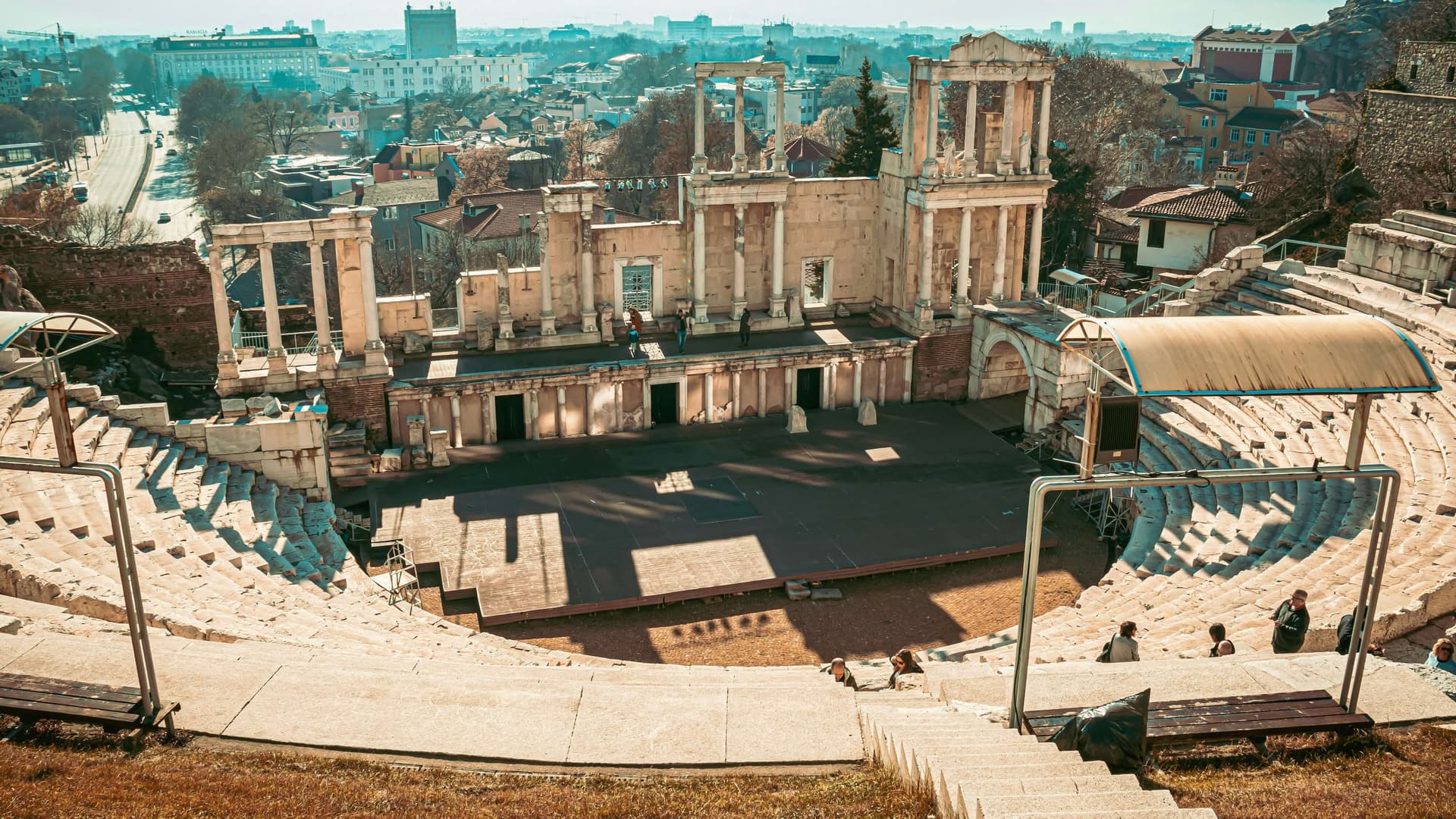
The Ancient Theatre of Philippopolis ranks among the finest and best-preserved ancient theatrical structures across the globe, operating as a primary tourist landmark of the city of Plovdiv. The monument was uncovered during large-scale archaeological excavations carried out from 1968 to 1979 by the Regional Archaeological Museum of Plovdiv. The site was formally designated an archaeological monument of culture in issue 6 of the State Gazette in 1995. The Theatre of Philippopolis stands as the only fully preserved ancient theater building across Bulgarian territories that remains completely adapted to accommodate modern cultural events.
It is worth noting that within popular public discourse, the monument is frequently misnamed the Amphitheatre. Within architectural and historical sciences, an amphitheater refers to a completely distinct structural type characterized by an elliptical layout designed for gladiatorial combat, whereas the Plovdiv landmark features the classic semi-circular profile of a Greco-Roman theater.
Chronology of Construction and Historical Adjustments
For decades, mainstream historical consensus assumed that the theater was erected during the reign of the Roman Emperor Marcus Ulpius Trajan, who ruled from 98 to 117 AD. However, during a recent archaeological survey, a valuable Greek inscription carved onto a statue pedestal was discovered and deciphered. The text praises a prominent citizen named Titus Flavius Cotys - a descendant of the final Thracian royal dynasty, a three-time high priest of the province of Thrace, supreme judicial representative of the metropolis of Philippopolis, and the director of municipal public works. According to this newly discovered epigraphic evidence, the Ancient Theatre was constructed slightly earlier - during the reign of Emperor Domitian of the Flavian Dynasty, in the final decade of the 1st century AD. Historians suggest that before the heavy marble venue was engineered, an ancient sanctuary or temple dedicated to the Thracian goddess Bendis occupied this location.
Topography and Architectural Blueprint
The Ancient Theatre is situated within the historic Old Town quarter of Plovdiv, anchoring the southern slope of the Three Hills inside the natural saddle formed between Dzhambaz Tepe and Taksim Tepe. All spectator seating is systematically oriented toward the south, providing ancient audiences with panoramic views over the lower city plains and the distant ridge of the Rhodope Mountains.
Architectural Parameters of the Structure:
- General Layout: In its structural blueprint, the theater forms a perfect semi-circle with an expansive outer diameter of 82 meters.
- Cavea (Auditorium): The open-air spectator tier incorporates 28 concentric rows fashioned from solid white marble. The seating is bifurcated horizontally into two grand tiers separated by a wide walkway known as a diazoma. Vertically, the sectors are divided by narrow radial staircases that shape the cavea into trapezoidal seating sections called kerkides.
- Orchestra: The marble tiers encircle the central stage floor, or orchestra, which features a distinct horseshoe shape with a diameter measuring 26.64 meters.
- Scaenae Frons (Stage Building): Standing along the southern rim of the orchestra is the majestic three-story scaenae frons. At its eastern and western boundaries, it terminates with projecting side wings known as proscenia, which house the staircases leading to the upper levels. The actual performance platform stands 3.16 meters high. Its facade facing the orchestra is richly decorated with an Ionic marble colonnade crowned by triangular tympanums. The main facade of the scaenae frons facing the audience consists of two tiers of porticos: the ground tier showcases the Roman-Ionic architectural order, while the upper tier displays the ornate Roman-Corinthian order. The entire facade is symmetrically split by three large entrance portals.
- Passageways and Vaults: The entrances to the orchestra, known as parodoi, were initially open-air corridors but were subsequently enclosed with masonry vaults. A specialized subterranean vaulted corridor initiates from the absolute center of the orchestra floor, passing directly beneath the stage architecture to exit outside the theater boundary. A second large vaulted passage runs beneath the central sector of the upper cavea tier, linking the theater directly with the upper plateau of the Three Hills. Positioned directly above this vault was the official imperial box reserved for the emperor and dignitaries.
Honorary Inscriptions and Gladiatorial Games
Mirroring the premier theaters across the Roman Empire, the VIP seats along the front rows at Philippopolis were custom-engraved. Archaeologists have documented numerous inscribed designations reserved for municipal magistrates, judges, and personal friends of the Roman emperor. These epigraphic records prove that the theater also operated as the official assembly hall for the Thracian Provincial Assembly (Thrakon Koinon).
The specific engineering modifications of the structure reveal that the venue was also utilized to host wild beast hunts and gladiatorial combats. Excavators discovered traces of iron safety barriers mounted directly in front of the primary seating row, alongside three additional staircases cutting through the podium to facilitate rapid public crowd management. Most likely, these adjustments were executed to accommodate the official state visit of Emperor Caracalla to Philippopolis in 214 AD, when major Alexandrian Games were celebrated in his honor.
Wartime Destruction, Excavation, and Anastylosis
At the close of the 4th century AD, a significant portion of the splendid marble structure was brought to ruin, with historians debating whether the collapse was triggered by a catastrophic fire during barbarian incursions or caused by a powerful earthquake.
The complete reconstruction of the Roman theater in Plovdiv is globally celebrated as one of the finest milestones achieved by the Bulgarian conservation school. The scientific project was managed by archaeologists Liliya Botusharova and Vera Kolarova. The structural intervention was restricted within parameters established via thorough archaeological studies, strictly avoiding subjective hypotheses. The reconstruction of the marble architectural elements was executed following the scientific method of anastylosis, where discovered original fragments are reassembled at their exact historical positions, while new supporting material is visibly and honestly demarcated.
Today, the Ancient Theatre represents the defining visual core of the southern slope of the Three Hills and remains a true emblem of Plovdiv. Capitalizing on its exceptional acoustic properties, which stem from its semi-circular design, the theater functions as an active open-air venue hosting classical dramas, opera festivals, dance troupes, and live concerts, comfortably accommodating an audience of 3500 spectators. Several perfectly preserved marble stelae and wall inscriptions in ancient Greek remain displayed across the architectural complex.
7-day forecast
Weather data from MET NorwayNearby Places

Lamartine House
Plovdiv region
0.1 km away
Djurkovi gallery
Plovdiv region
0.2 km away
Hipokrat museum
Plovdiv region
0.2 km away
More to explore

Read more in our travel guides

Getting to Plovdiv: The Airport, Sofia Transfers & Trains
How to get to Plovdiv: Plovdiv Airport (PDV) routes, train and bus options from Sofia, private transfers, costs, and travel times.
One Week in Bulgaria: The Ultimate 7-Day Travel Itinerary
The complete 7-day Bulgaria travel itinerary: explore Sofia, Rila Monastery, Plovdiv, Veliko Tarnovo, and the Black Sea coast with distances and travel times.

10 Days in Bulgaria: The Ultimate Grand Tour Itinerary
A complete 10-day Bulgaria itinerary: explore Sofia, Rila Monastery, Plovdiv, the Rose Valley, Veliko Tarnovo, and the Black Sea coast.
Frequently asked questions
Where is Ancient Theatre of Philippopolis located?
Ancient Theatre of Philippopolis is located in Plovdiv, Bulgaria.
How do I get to Ancient Theatre of Philippopolis?
Ancient Theatre of Philippopolis is most easily reached by car. Use the coordinates above to navigate, or open the location in OpenStreetMap or your preferred maps app for turn-by-turn directions. Public transport options vary by region — for remote destinations a rental car gives the most flexibility.
What is the best time to visit Ancient Theatre of Philippopolis?
Ancient Theatre of Philippopolis can be visited year-round. Spring and autumn offer the most pleasant conditions for exploring, with mild temperatures and fewer crowds. Summer is ideal for photography and longer day trips; winter visits are possible but weather can limit access at some sites.
What should I know before visiting Ancient Theatre of Philippopolis?
Most natural landmarks in Bulgaria are freely accessible and open year-round, though some sites have entrance fees or require a guide. Wear sturdy footwear and bring water, as the terrain can be uneven. Respect any protective barriers and stay on marked paths to preserve the site.