

Krushuna Falls: Bulgaria's Turquoise Cascades
In this guide▾
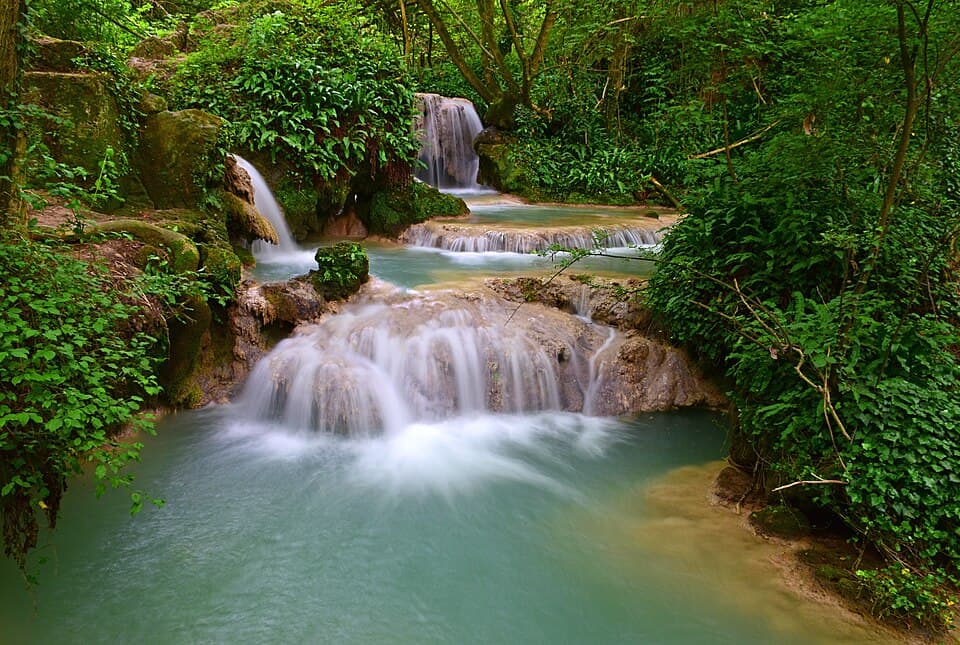
Bulgaria does not lack waterfalls — but it has nothing else like Krushuna. Here a karst river slides off the Devetashko Plateau and, over thousands of years, has built its own staircase: terrace after terrace of soft travertine limestone, each brimming with a milky-turquoise pool, each spilling into the next through veils of white water and moss. It is the largest travertine cascade in the country and, on a bright late-spring day, one of the most purely beautiful places in Bulgaria.
This guide covers the eco-trail, fees, the best season and light, and how Krushuna slots into northern Bulgaria's great karst day out. For the wider list it belongs to, see Bulgaria's natural wonders.
📍 What Exactly Are the Krushuna Falls?
Krushuna Falls begin as a karst spring inside the Maarata cave above the village of Krushuna, in Letnitsa municipality, Lovech province. The water is saturated with dissolved limestone, and as it flows and aerates it deposits travertine — the same stone that built Pamukkale in Turkey. The result is a living formation that is still growing: rounded terraces, petrified "curtains," and pools whose mineral content scatters light into that improbable green-blue.
The main fall drops about 20 meters in a wide fan over a mossy amphitheater, but the real magic is the full sequence — dozens of smaller cascades and pools descending through the forest for several hundred meters, changing color with every hour of light.

🚗 Getting There
Krushuna village lies in the low karst country between Lovech and the Danube plain.
| From | Distance | Driving time |
|---|---|---|
| Devetashka Cave | ~16 km | ~20 min |
| Lovech | ~35 km | ~40 min |
| Veliko Tarnovo | ~77 km | ~1 h 10 min |
| Sofia | ~185 km | ~2 h 30 min |
By car (essentially the only way): from Sofia, take the Hemus motorway east and turn north toward Lovech and Letnitsa. The roads are asphalt all the way. Signage is good and the falls are impossible to miss.
Parking: there is a car park by the entrance at the edge of the village, a few minutes' walk from the start of the eco-trail, costing about €2 for the whole day with no time limit (checked September 2026). On summer weekends it fills from mid-morning — another reason to arrive early.
Coming from the east, Krushuna pairs perfectly with a Veliko Tarnovo weekend; from the west it caps the karst trio described below.
🥾 The Eco-Trail
- The lower loop is a short, family-friendly circuit on wooden bridges and steps past the main falls and the biggest pools — about 20–30 minutes, with little climbing.
- The upper path climbs more steeply beside the higher terraces to the Maarata spring cave, where the river pours straight out of the rock. To see everything at an unhurried pace, allow 1.5–2 hours in total, and expect wet, slippery sections.
- Opening hours: 08:00–20:00 in the warm months. Out of season there are no fixed hours, so go during daylight.
- Entrance fee: about €3 for adults and €2 for children (checked September 2026), paid in cash at the entrance; it maintains the walkways. Children under 7, visitors with disabilities and residents of Letnitsa municipality enter free.
- Facilities: there are toilets, picnic tables and a restaurant near the entrance, an outdoor swimming pool by the car park in summer — the place to swim, since the falls themselves are off limits — and mehanas in the village.
- Closed sections: in November 2015 a rockfall at the falls killed two visitors. The site reopened in April 2016 with the trail rerouted, and some parts of the old path are still closed — obey the "no entry" signs.
- The travertine is extremely slippery where wet — good soles matter more here than on many mountain trails.

📸 Season & Light
- Late April to June is prime: maximum water, electric-green moss, and the pools at their most opaque turquoise.
- High summer brings the biggest crowds and thinner flow up top; in dry years the upper terraces can fade by late August.
- Autumn trades water volume for golden leaves over the pools — a photographer's trade worth making.
- Light: the falls face into forest shade, so soft overcast light or early morning works beautifully; a polarizing filter (or just angling your phone) deepens the pool colors. Long exposures turn the veils to silk — bring something to steady the camera.
- Crowds: summer weekends are busy from mid-morning; arrive before 10 am, or come on a weekday and have whole terraces to yourself.
🗺️ The Karst Trio: Krushuna + Devetashka + Prohodna
Krushuna is one corner of northern Bulgaria's best nature day:
- Devetashka Cave (~20 min away) — a colossal daylight cavern on the Osam River, its ceiling skylights raining sun onto a green floor.
- Krushuna Falls — the turquoise staircase, ideally around midday when you can linger.
- Prohodna Cave (~1 h 30 min west) — the "God's Eyes" rock tunnel; see our dedicated Prohodna guide for timing the light on the Eyes.

All three fit into one ambitious day from Sofia or, more comfortably, a relaxed loop on the way to or from Veliko Tarnovo. The surrounding Devetashko Plateau is honeycombed with further caves and sinkholes for those who want to keep exploring.
💡 Practical Tips
- Cash for the entrance fee and parking — card acceptance is hit-and-miss.
- Shoes with grip, not sandals — wet travertine is as slick as ice in places.
- Swimming is banned. The pools are a protected natural landmark and the travertine is fragile — stay on the trail, never climb the wet cascades, and follow the rules posted at the entrance. To cool off, use the swimming pool by the car park or one at your hotel.
- Drones — check the current rules at the entrance and respect other visitors; the terraces photograph best from the boardwalks anyway.
- Combine, always — Krushuna alone is a lovely hour; the karst trio is an unforgettable day.
Make a full day of it with the giant Devetashka Cave and the God's-eyes Prohodna in our Devetashka Cave & Lovech karst guide.
👨👩👧👦 Is It Suitable for Children?
Yes — it's one of the best family outings in northern Bulgaria.
- The lower loop is short, with wooden bridges and railings, and suits children who can walk on their own.
- The upper path to Maarata is steeper and slippery — fine for older children, with a hand to hold on the wet steps.
- Pushchairs won't manage the steps; bring a child carrier for toddlers.
- Children under 7 enter free, and the picnic area and summer swimming pool by the car park make it an easy half-day.
🏨 Where to Stay
- Krushuna village: guesthouses a short walk from the falls — quiet and green, and the easiest way to be on the trail before the crowds.
- Lovech (~40 min): more hotels, restaurants and the old Varosha quarter, and a good base for Devetashka Cave too.
- Veliko Tarnovo (~1 h 10 min): the biggest choice, if you're combining the falls with a city weekend.
🧭 What Is Nearby
- Devetashka Cave (~20 min) — the colossal cave with light pouring through its roof.
- Lovech (~40 min) — the covered bridge and the Varosha old quarter.
- Kakrina Inn (~55 min) — the inn where Vasil Levski was captured in 1872, now a museum.
A river that builds its own monument, one limestone layer at a time — and it's been at work for millennia. Walk the terraces, count the shades of turquoise, and keep exploring Bulgaria's wild side with Mestala.com.
This guide covers 5 places
Want more Mestala in your Google results?
Add mestala.com as a preferred source and our guides will show up more often when you search. Requires a Google account.
Frequently Asked Questions
Where are Krushuna Falls and how do you get there?▾
Krushuna Falls sit at the edge of the village of Krushuna in Letnitsa municipality, Lovech province, northern Bulgaria — about 35 km from Lovech, 16 km from Devetashka Cave, 77 km from Veliko Tarnovo and roughly 185 km (2.5 hours) from Sofia. You park by the entrance at the edge of the village. There is no practical public-transport option, so plan on driving.
What makes Krushuna Falls special?▾
They are Bulgaria's largest travertine cascade: mineral-rich karst water flowing off the Devetaki Plateau has built terraces of soft, moss-covered travertine, and the river spills over them in dozens of milky-turquoise pools and veils. The main fall drops about 20 meters, but the signature sight is the whole staircase of pools glowing green-blue in the forest.
Is there an entrance fee at Krushuna Falls?▾
Yes. Tickets are sold at the trail entrance and cost about €3 for adults and €2 for children (checked September 2026), with parking about €2 for the whole day. The money goes toward maintaining the bridges, railings and steps of the eco-trail. Children under 7, visitors with disabilities and residents of Letnitsa municipality enter free. Bring cash, as card payment isn't guaranteed. In the warm months the site is open 08:00–20:00; out of season, go in daylight.
How long is the Krushuna Falls eco-trail?▾
The lower loop past the main falls and pools is short — about 20 to 30 minutes with little climbing. A steeper path climbs beside the upper cascades to the Maarata cave, where the water emerges from the rock. Seeing everything at an unhurried pace takes about 1.5 to 2 hours. Some sections have been closed since a rockfall in 2015, so follow the signs.
When is the best time to visit Krushuna Falls?▾
Late spring is peak season — snowmelt and rain keep every terrace flowing and the greenery is at its brightest. Early summer stays lovely; by late August dry years can reduce the upper cascades to a trickle. Autumn adds golden foliage over the turquoise pools. Weekends get crowded from May to September, so arrive before 10 am or visit on a weekday.
Can you swim at Krushuna Falls?▾
No — swimming in the falls is banned. They are a protected natural landmark, the travertine terraces are fragile and very slippery, and there are no lifeguards. Stay on the trail, never climb the cascades, and follow the rules posted at the entrance. To cool off in summer, use the outdoor swimming pool by the car park or a hotel pool.
Is Krushuna Falls safe?▾
Yes, if you stay on the trail. In November 2015 a rockfall at the falls killed two visitors, after which the site was closed, the loose rock was cleared and the trail was rerouted away from some of the falls; it reopened in April 2016. Parts of the old path are still closed. Obey the 'no entry' signs, keep to the boardwalks and bridges, and wear shoes with grip.
You might be interested in
The Rhodopes: A Complete Travel Guide to Bulgaria's Mystical Mountains
Everything you need to plan a Rhodope Mountains trip: Smolyan, Pamporovo, Trigrad Gorge, Shiroka Laka, Perperikon, caves, spa towns, food, itineraries and when to go.
Botev Peak & Raysko Praskalo: Hiking the Central Balkan
How to hike Botev Peak (2,376 m), the highest summit of the Balkan Mountains, from Kalofer — past Raysko Praskalo, the highest waterfall in the Balkans.

Cherni Vrah: Hiking Vitosha's Summit from Sofia
How to hike Cherni Vrah (2,290 m), the summit of Vitosha above Sofia — the route from Aleko, bus 66, the lifts that still run, difficulty, and season.
Malyovitsa: Rila's Most Iconic Day Hike
How to hike Malyovitsa (2,729 m), the cradle of Bulgarian mountaineering in northern Rila — the route from the resort and hut, parking, difficulty and season.