

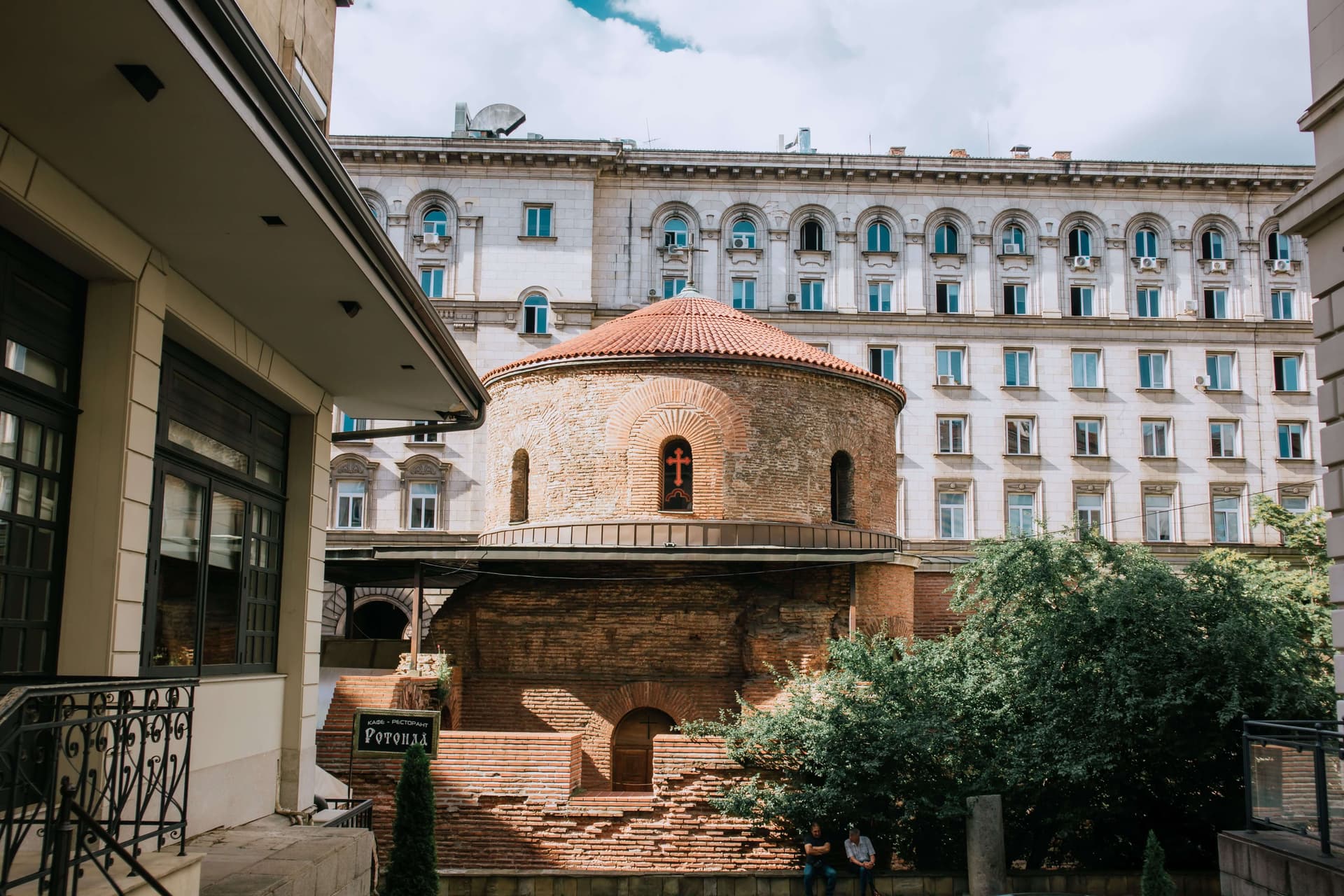
Saint George Rotunda
The Orthodox Church of Saint George, constructed in the classic architectural form of a rotunda, is a phenomenal historical monument erected during Late Antiquity in the Bulgarian capital city of Sofia. The sanctuary is situated within the enclosed inner courtyard between the massive buildings of the Balkan Hotel and the President's Palace, positioned on an archaeological layer several meters below modern Sofia streets. It is widely recognized as the oldest fully preserved architectural structure in the city. The Rotunda was built in the early 4th century, no later than the period when ancient Serdica served as the imperial residence for Emperors Galerius and Constantine the Great.
To this day, daily Orthodox services are held inside the temple in the ancient liturgical language of the Orthodox Slavs - Old Church Slavonic. The choral chants are performed in the traditional Eastern Orthodox style, recognized in musical history as Bulgarian and Byzantine chant.
Architectural Impact and the Archaeological Complex
Despite its modest spatial dimensions, this monument exhibits striking structural similarities to the famous Saint George Rotunda located in the city of Thessaloniki. Carrying the authentic spirit of the early Christian era and the Bulgarian Middle Ages, the temple commands an imposing visual presence, drawing scientists, cultural figures, historians, and numerous Orthodox and Catholic pilgrims from across the globe. On special public occasions, solemn military ceremonies and concerts of classical and sacred Orthodox music are held in the square outside the Rotunda.
The church forms the core of a much larger, expansive archaeological complex:
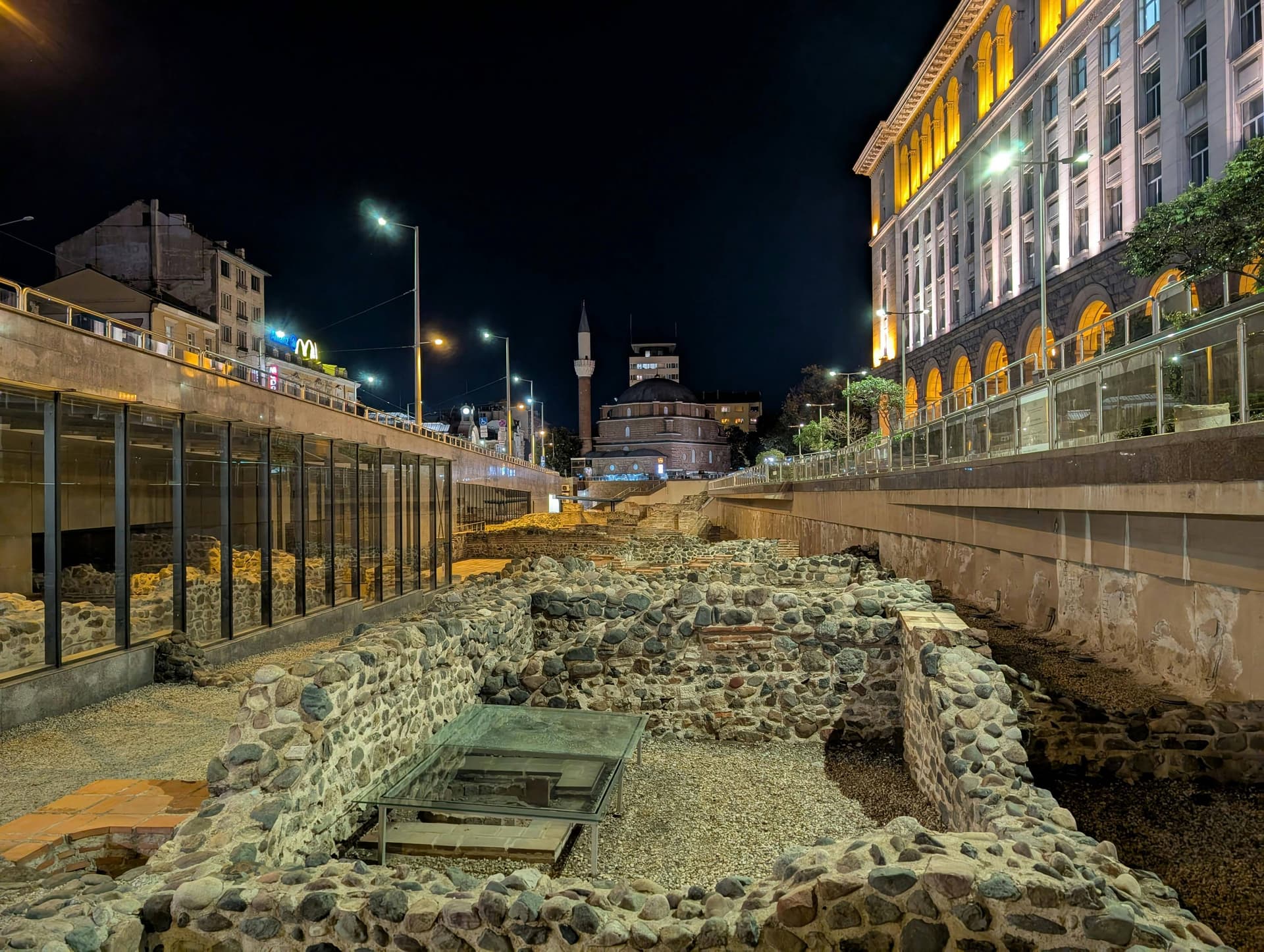
- Behind the central apse, remnants of an authentic Roman street featuring a well-preserved drainage system have been excavated.
- The heavy stone foundations of a large three-nave basilica, which most likely operated as a public administrative building, are fully exposed.
- One of the adjacent structures features an original Roman underfloor heating system, known as a hypocaust, with the ceramic tiles that elevated the floor still visible to tourists today.
Experts designate this entire area as one of the most beautiful and representative zones within the so-called Constantine Quarter of ancient Serdica-Sredecs, where the imperial urban palace of Emperor Constantine the Great was historically located.
Hypotheses on Initial Functionality
The original functional purpose of the Rotunda has been the subject of long academic debates. Professor Bogdan Filov initially suggested that the building was constructed as a Roman bathhouse, confusing the subfloor channels with a traditional hypocaust system. Subsequent research, however, proved that these underfloor channels were designed for continuous ventilation to combat groundwater moisture. The leading contemporary scientific hypotheses conclude that the structure was engineered as an imperial mausoleum, a martyrium, or a ceremonial ritual hall. It was formally converted into a Christian church during the 6th century.
Historical Chronicles and the Translation of Holy Relics
Over the centuries, the Rotunda guarded some of the most precious spiritual treasures of the Balkans. For long periods, it housed the holy relics of the celestial patron of Bulgaria - Saint Ivan of Rila, which, according to historical accounts, miraculously healed the Byzantine Emperor Manuel First Komnenos. The relics were violently seized by Hungarian forces in 1183 during the reign of King Bela Third, when a joint Hungarian and Serbian invasion overran Sredec, plundering the city. The holy remains were taken to the Hungarian capital of Esztergom, where the local Catholic bishop treated the relic with disrespect and subsequently lost his speech. Terrified by the miracle, the Hungarians returned the relics to Bulgaria in 1187.
The relics of the Rila protector rested inside the Rotunda for a second time in 1469, during a massive, solemn religious procession carrying the saint from the old capital of Tarnovgrad back to the Rila Monastery. Originally, the canonized Serbian King Stefan Milutin was also buried inside the temple, though his relics were later translated to the Saint King Church, known today as the Holy Nedelya Cathedral.
Veneration of Saint George of Sofia the Newest
The Rotunda is one of the two historic churches in Sofia that commemorate May 26 with deep religious and civic honor - the feast day of the Sofia martyr Saint Martyr George of Sofia the Newest. His historical grave is located along the exterior northern side of the Rotunda's main apse. The other shrine dedicated to his memory is the chapel inside the courtyard of the Alexandrovska Hospital, built on the exact spot where the saint was martyred by the Ottoman forces. The large religious procession in honor of the Sofia martyr takes place annually on the eve of the holiday, May 25.
Scientific Research, Conservation, and Restoration
The first systematic archaeological excavations inside the Rotunda were carried out by the celebrated Bulgarian scholar Professor Bogdan Filov in 1915, 1921, and 1932, culminating in his fundamental scientific monograph published in 1933. In the late 1980s, a comprehensive, high-precision conservation and restoration of the building was finalized. Thanks to these modern preservation efforts, the monument has successfully reclaimed its authentic appearance, mirroring its Late Antique and medieval prototype.
7-day forecast
Weather data from MET NorwayNearby Places

More to explore

Read more in our travel guides
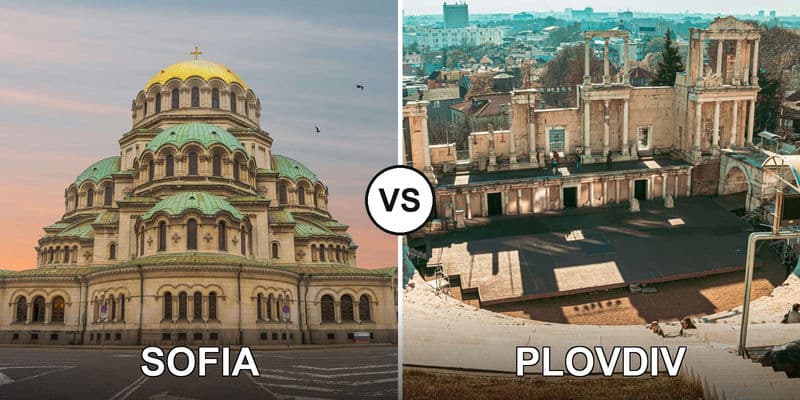
Sofia vs Plovdiv: Which City to Visit?
A comparison of Sofia and Plovdiv: atmosphere, historic landmarks, restaurants, the Kapana district, nightlife, and practical travel tips.
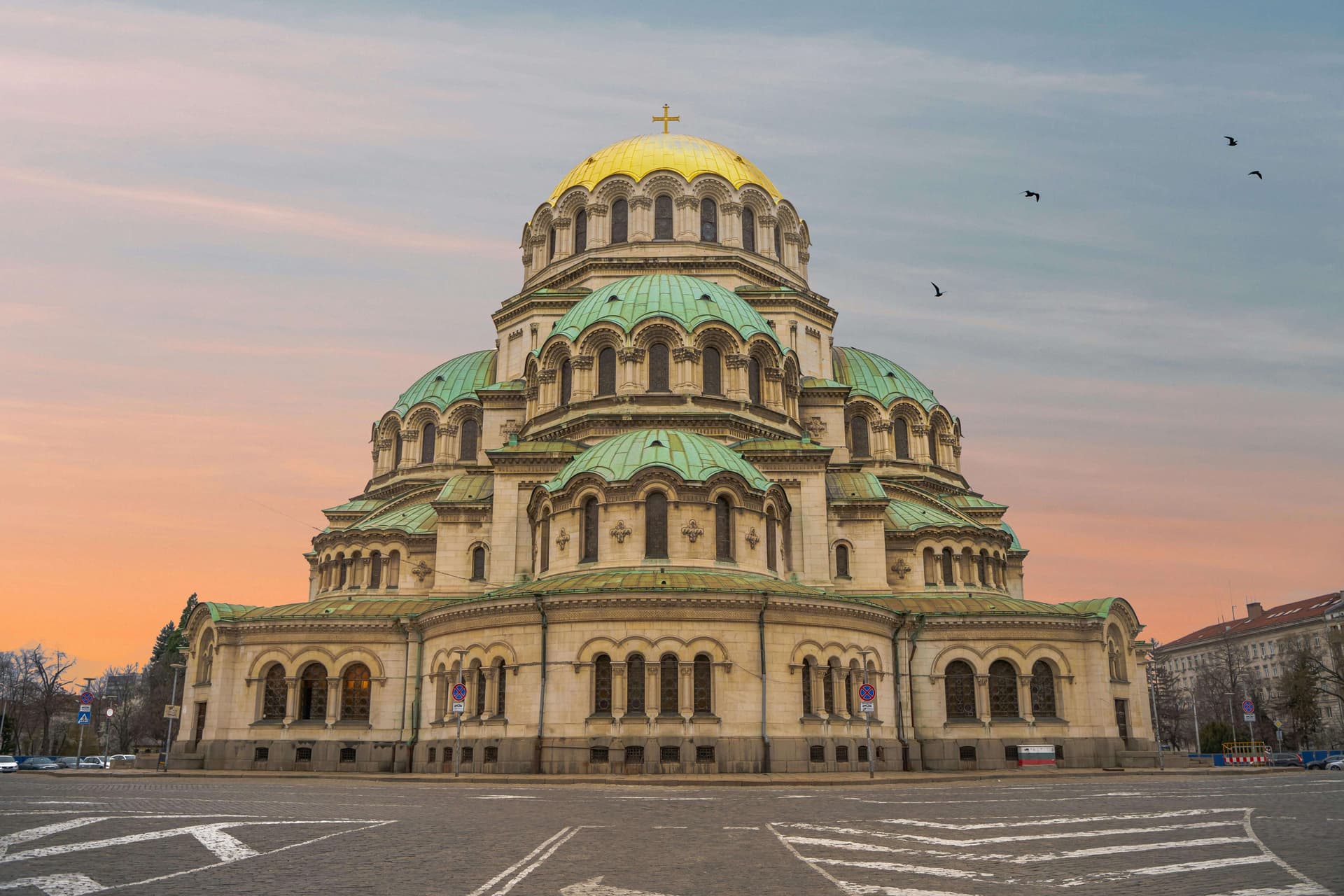
72 Hours in Sofia: The Perfect Weekend Itinerary
The perfect 3-day weekend itinerary for Sofia — from St. Alexander Nevsky and Roman Serdica to Vitosha Mountain and Boyana Church. Plus parking and family tips.
Frequently asked questions
Where is Saint George Rotunda located?
Saint George Rotunda is located in Sofia City, Bulgaria.
How do I get to Saint George Rotunda?
Saint George Rotunda is most easily reached by car. Use the coordinates above to navigate, or open the location in OpenStreetMap or your preferred maps app for turn-by-turn directions. Public transport options vary by region — for remote destinations a rental car gives the most flexibility.
What is the best time to visit Saint George Rotunda?
Saint George Rotunda can be visited year-round. Spring and autumn offer the most pleasant conditions for exploring, with mild temperatures and fewer crowds. Summer is ideal for photography and longer day trips; winter visits are possible but weather can limit access at some sites.
What should I know before visiting Saint George Rotunda?
Most natural landmarks in Bulgaria are freely accessible and open year-round, though some sites have entrance fees or require a guide. Wear sturdy footwear and bring water, as the terrain can be uneven. Respect any protective barriers and stay on marked paths to preserve the site.