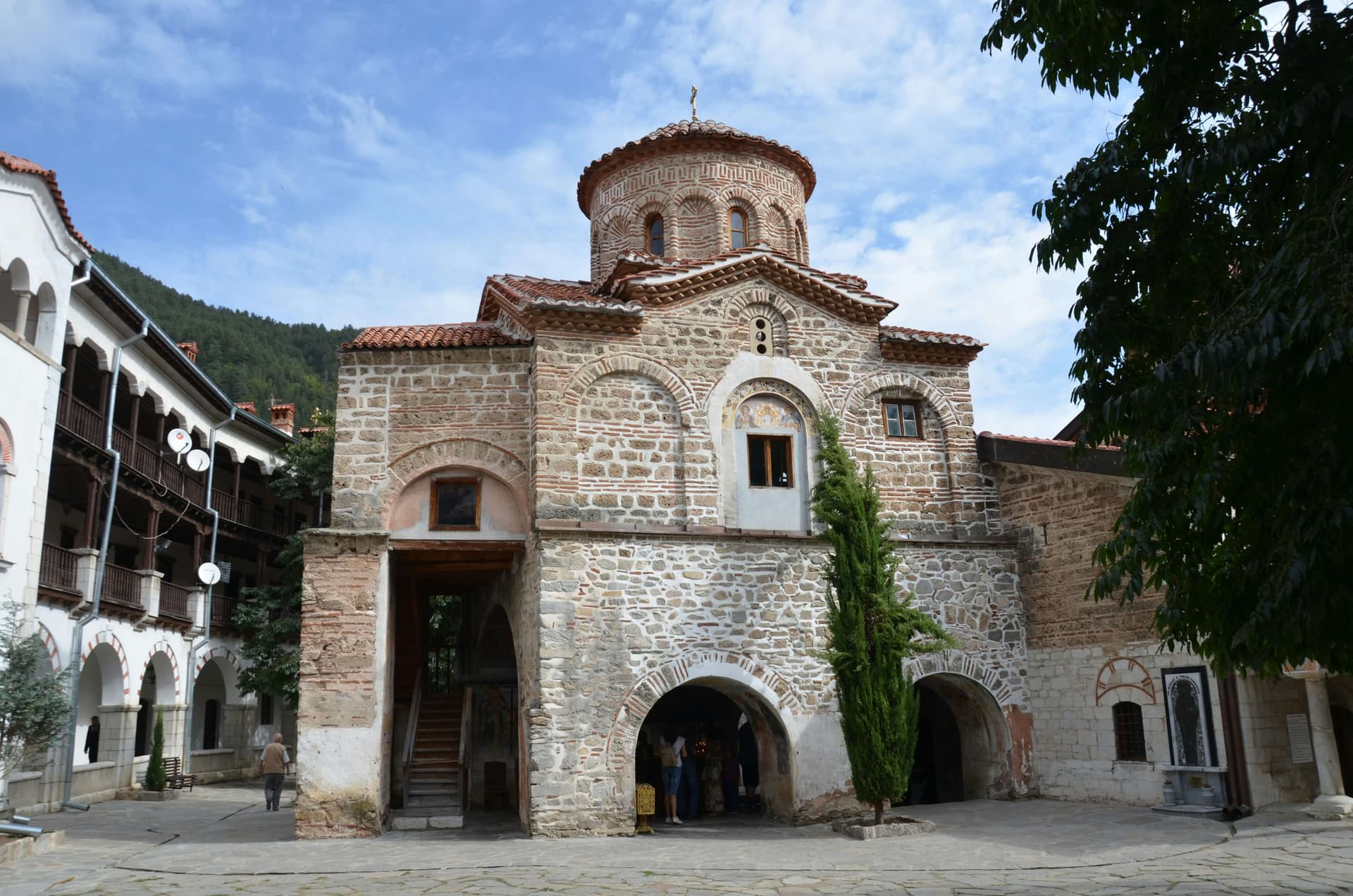
The Bachkovo Monastery of the Dormition of the Mother of God (Успение Богородично) stands as a monumental stavropegial monastery belonging to the Bulgarian Orthodox Church, situated near the scenic mountain village of Bachkovo, Asenovgrad Municipality within the Plovdiv Province. It commands an exceptional national status, operating as the second-largest and historically prominent Bulgarian monastic complex, surpassed only by the Rila Monastery. The official patronal feast day of the Bachkovo Stavropegion is celebrated with high solemnity on the Dormition of the Mother of God on August 15. The complex occupies a highly picturesque location nestled within the valley carved by the Chepelare River, which is widely recognized among local populations as the Chaya River, positioned roughly 10 kilometers south of the town of Asenovgrad. Enclosed symmetrically by the steep ridges of the Rhodope Mountains, the monastery's monumental architectural scale and rich centuries-old history establish it as one of the most visited and revered centers for pilgrimage and cultural tourism across Bulgaria. The Supreme Holy Relic - The Miraculous Icon of the Virgin Mary The spiritual core and supreme holy relic of the Bachkovo Monastery is its ancient icon of the Blessed Virgin Mary. It is preserved year-round inside a custom-engineered and highly decorated shrine positioning within the central catholicon (main cathedral). Due to its verified history of miraculous conditioning, the icon serves as a constant destination for an uninterrupted flow of Orthodox pilgrims and international travelers. Of the original underlying painting, only the custom-frescoed faces of the Virgin Mary and the Infant Jesus remain visible today. The entire remaining surface of the composition is covered by two heavy silver revetments (oklads) offered as a sign of supreme veneration: - The Ancient Silver Oklad: It preserves an authentic incised inscription confirming that this fine piece of liturgical art was officially presented to the shrine in 1311 AD by the noble Georgian dignitaries Athanasius and Okropir, whose name translates literally as Golden-Mouthed (Chrysostom). - The Modern Silver Oklad: This protective layer dates to a later historical epoch, crafted in 1819. Historical Written Records and Travelers' Testimonies The earliest surviving written account documenting the existence of and veneration toward this icon within European literature is provided by the French explorer and traveler Paul Lucas, who visited the monastic complex in 1706. In his personal travel journals, he recorded witnessing an image of the Holy Virgin, custom-painted according to the statements of local monks by the hand of Saint Luke the Evangelist himself. The Frenchman noted that the brothers shared diverse folklore accounts regarding the artifact, claiming above all that they possessed it by virtue of a miracle, the icon having migrated to their monastery from the lands of Georgia. Paul Lucas summarized that this image operated as one of the preeminent regional holy relics, drawing immense crowds to Bachkovo. Vital details are further preserved in the scholarship of the Plovdiv priest Konstantin Ikonom. In his thorough cataloging of the Plovdiv Diocese published in 1819, he noted that the exact methodology and timeline regarding the translation of the icon to the monastery remained unverified by science. The educator described an old popular legend indicating that following the Ottoman conquest of Thrace, the icon was concealed and later discovered inside a rock cavern. This cave is located half an hour's walking distance south of the monastery along the mountain gorge at a locality known as Klovion or Kluviyata, where a small Church of the Virgin Mary stands today next to a holy water spring (ayazmo). Konstantin Ikonom added that every year on the second day of Easter (Bright Monday), the day the relic is believed to have been discovered, the faithful carry the icon in a solemn religious procession (lite) to the aforementioned Klovion locality to celebrate a festive Holy Liturgy inside the adjacent chapel, with the procession engaging an immense gathering of people coming from all neighboring villages and towns. The Legend of Kluviyata and the Easter Religious Procession Modern research compiled by Aleksandra Karamihaleva in 2007 highlights the preserved oral traditions of the monastery. The legend narrates that the icon literally flew from an Orthodox Georgian monastery and landed upon the cliffs of the Kluviyata locality near Bachkovo. At the absolute moment of its landing, a powerful yet completely unburning and magical fire erupted. Two local shepherds, who were brother and sister, witnessed the unquenchable flames from the hills for three consecutive nights before approaching to investigate the miraculous sign. They discovered the icon and immediately informed the monastic brotherhood. The monks advanced to the site and transferred the relic to the main Church of the Virgin Mary with a solemn procession, positioning it on the central iconostasis. To the surprise of the community, the icon repeatedly fled the church over subsequent days, returning autonomously to the cliffs of Kluviyata, forcing the brothers to locate it and return it to the monastery. This phenomenon ceased only after the Virgin Mary appeared in a dream to a righteous monk. She revealed her divine will, stating that she would remain permanently within the monastery complex only if granted a designated position of honor to the right of the main temple entrance. Her objective was to clearly observe the hearts and intentions of everyone crossing the threshold of God's house. An additional condition mandated that every year on the second day of Easter, the monks must guide her back via a procession to her original site of discovery. The brotherhood fulfilled the mandate, positioning the icon upon a high throne to the right of the main entrance where it remains displayed to this day, rendering the annual Easter lite the oldest and largest continuous religious procession in Bulgaria. The Monastery Museum and the Dispersed Cultural Treasury The Bachkovo Monastery operates its own extensive museum exhibition, where travelers can explore precious liturgical vessels, historic oklads, ancient church manuscripts, and unique examples of Eastern Orthodox Christian art representing diverse historical eras. Among the exhibits, a large silver paten (diskos) stands out as highly significant to scholars. According to its verified Old Church Slavonic inscription, this diskos was crafted by the prominent Chiprovtsi master Petar and presented to the cloister in 1644 by the distinguished citizen Theodosius from the town of Peshtera. Due to the complex historical turbulence of the region, several priceless artifacts and documents originating directly from the Bachkovo Monastery are currently preserved within major external scientific and museum institutions: - In Sofia: A portion of the artifacts is displayed inside the galleries of the National Church Historical and Archaeological Museum. - In Athens: Precious medieval objects are integrated into the permanent collection of the renowned Byzantine and Christian Museum. - The Monastic Library: The vast majority of priceless medieval manuscripts, parchments, and early printed books representing the historic monastic library are currently safeguarded inside the specialized repositories of the Church-Historical and Archival Institute of the Bulgarian Orthodox Church in Sofia.

Plovdiv
2.9 km away
Plovdiv
3.3 km away
Plovdiv
4.2 km away
A practical guide to Chepelare: the Mechi Chal ski area, Snezhanka Peak, getting there from Plovdiv, parking, where to stay, and why it beats Pamporovo on price.

When the Bulgarian grape harvest happens, which wine regions to visit in September and October, how a harvest day works and what to book in advance.

E-vignette prices, speed limits, winter tyre rules and rental gotchas — plus an honest answer on whether you need a car in Bulgaria at all.
Bachkovo Monastery is located in Plovdiv, Bulgaria.
Bachkovo Monastery is most easily reached by car. Use the coordinates above to navigate, or open the location in OpenStreetMap or your preferred maps app for turn-by-turn directions. Public transport options vary by region — for remote destinations a rental car gives the most flexibility.
Bachkovo Monastery can be visited year-round. Spring and autumn offer the most pleasant conditions for exploring, with mild temperatures and fewer crowds. Summer is ideal for photography and longer day trips; winter visits are possible but weather can limit access at some sites.
Most natural landmarks in Bulgaria are freely accessible and open year-round, though some sites have entrance fees or require a guide. Wear sturdy footwear and bring water, as the terrain can be uneven. Respect any protective barriers and stay on marked paths to preserve the site.