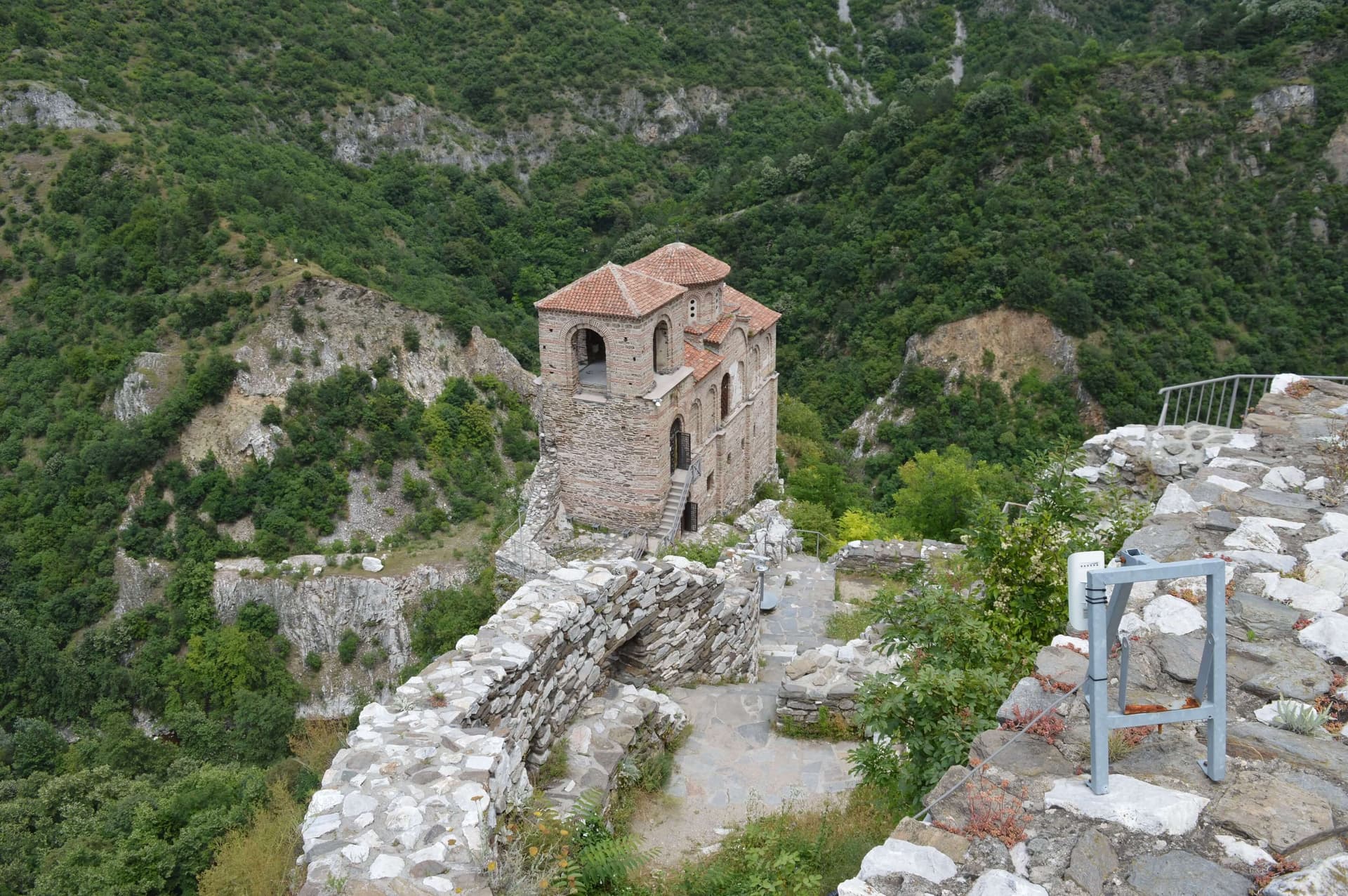
The Asen Fortress (Asenova Krepost) is a monumental medieval stronghold, within whose perimeter stands the perfectly preserved two-story fortified Church of the Holy Mother of God of Petrich (Света Богородица Петричка). This iconic monument is situated in the scenic lower ridges of the Rhodope Mountains, positioned strategically at a distance of 2 kilometers from the contemporary town of Asenovgrad. Due to its outstanding historical, architectural, and cultural value, the Asen Fortress is officially declared a national monument of culture holding paramount significance. The destination is integrated under a designated honorary number into the prestigious list of the 100 National Tourist Sites compiled by the Bulgarian Tourist Union, and it houses the official validation stamp for traveler collection books. The fortress welcomes tourists and remains open for public visits year-round without weekly holidays. Historical Timeline and Strategic Value Morphological and archaeological surveys demonstrate that the high, steep rock terrace hosting the complex was utilized for military fortification as early as the Thracian era, with ancient tribes capitalising on the natural defense parameters of the terrain. Subsequently, the fortified settlement was thoroughly reconstructed by the Eastern Roman Empire (Byzantium) during the 9th century AD. The primary military assignment of the Byzantine garrison was to securely guard the gateway of the critical Aegean Pass and stabilize the imperial frontier across this mountain region. The earliest official written records attesting to the existence of the fortress date back to the 11th century. They were discovered within the preserved authentic typikon (charter) of the nearby Bachkovo Monastery, established during that same epoch. These historical texts confirm that the Asen Fortress commanded a high administrative status, operating its own developed military security forces, an armory, and an independent internal administration. During the turbulent events driving the Fourth Crusade, the stronghold was besieged, captured, and briefly managed by Western European knights and crusaders. The fortress functioned actively as a defensive military facility until 1410, when it was brought to ruin by Ottoman forces during the internal dynastic conflicts inside the Ottoman Empire. The Era of King Ivan Asen II and the Famous Rock Inscription The fortress received its modern popular title in honor of the legendary Bulgarian monarch, Tsar Ivan Asen II. Following his decisive triumph at the Battle of Klokotnica, the Bulgarian king initiated a massive state-funded border reinforcement campaign in 1231, executing numerous repairs, structural expansions, and massive masonry works along the curtain walls to maximize the site's structural integrity. A testament to this extensive engineering achievement is the famous authentic medieval inscription, carved by royal command directly onto one of the vertical rock faces of the hill. The text of this historic epigraphic monument reads: In the year 6739 (corresponding to 1231 AD), the fourth indiction, the god-elevated King Asen of the Bulgarians, Greeks, and other lands, positioned Alexius the Sevast and built this city. Within this specific historical context, the word alexius does not represent the personal proper name of a specific human individual; instead, it is utilized semantically to signify a defender or guardian, which reflects the literal meaning of this concept when translated from ancient Greek. The term Sevast, on the other hand, represents a high medieval administrative and noble title bestowed upon official governors ruling large provinces known as chorae, or smaller administrative-territorial units integrated within them. Numerous contemporary historians and medievalists accept in their research that within medieval Bulgaria, the title sevast carried distinct semantic values across separate cases. Beyond being directly linked to the actual execution of specific administrative, judicial, and military duties on behalf of the crown, it frequently operated as a purely honorary noble title illustrating close proximity to the royal court. The Church of the Holy Mother of God of Petrich - A Masterpiece of Medieval Architecture The defining and most visually arresting element of the entire complex is the fully preserved, single-apsed, two-story Church of the Holy Mother of God of Petrich, which rises proudly along the steep edge of the cliff. The lower tier of the structure functioned as a crypt (ossuary) and utility storage space, while the upper level accommodates the actual Eastern Orthodox temple. The exterior of the church is richly decorated with blind arches and pilasters highly characteristic of the Tarnovo and Nesebar medieval architectural schools. Inside the shrine, valuable fragments of medieval frescoes and wall paintings dating to the 14th century are partially conserved, attracting the attention of historians and art experts from across the globe.

Plovdiv
0.8 km away
Plovdiv
1.5 km away
Plovdiv
2.1 km away
Plovdiv
2.3 km away

The best day trips from Plovdiv: Bachkovo Monastery, Asen's Fortress, the Rose Valley, Buzludzha, Koprivshtitsa and more — with distances and how to go.

A comparison of Sofia and Plovdiv: atmosphere, historic landmarks, restaurants, the Kapana district, nightlife, and practical travel tips.
Asen's Fortress is located in Plovdiv, Bulgaria.
Asen's Fortress is most easily reached by car. Use the coordinates above to navigate, or open the location in OpenStreetMap or your preferred maps app for turn-by-turn directions. Public transport options vary by region — for remote destinations a rental car gives the most flexibility.
Asen's Fortress can be visited year-round. Spring and autumn offer the most pleasant conditions for exploring, with mild temperatures and fewer crowds. Summer is ideal for photography and longer day trips; winter visits are possible but weather can limit access at some sites.
Most natural landmarks in Bulgaria are freely accessible and open year-round, though some sites have entrance fees or require a guide. Wear sturdy footwear and bring water, as the terrain can be uneven. Respect any protective barriers and stay on marked paths to preserve the site.