

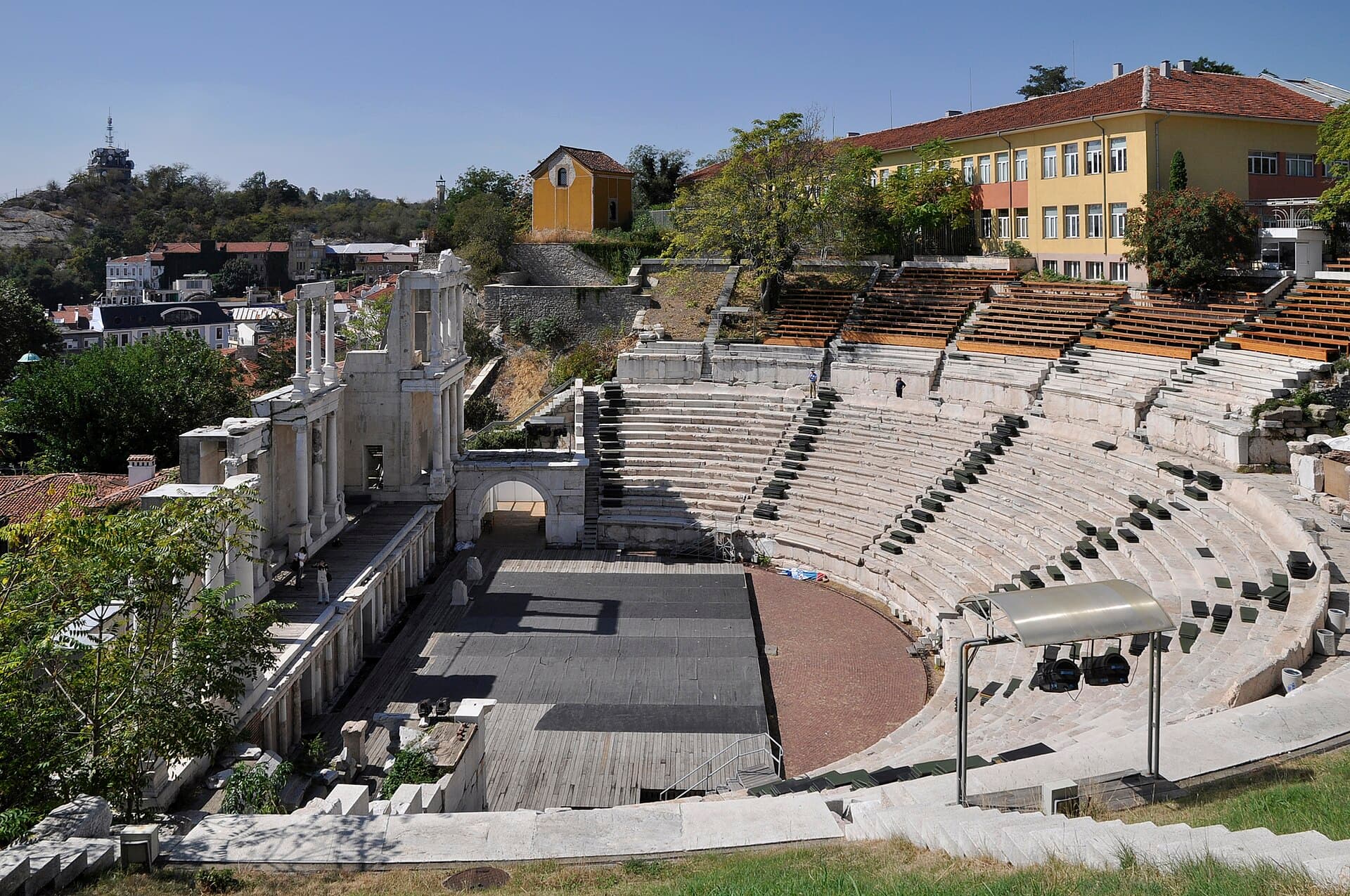
South-Central Bulgaria
Roman Theatre, Plovdiv · Wikimedia Commons (CC-BY-SA)
South-Central Bulgaria is one of the country's six planning regions and covers the oblasts of Kardzhali, Pazardzhik, Plovdiv, Smolyan, and Haskovo. It spans 22,365 km² and has a population of about 1.542 million (2008). Plovdiv is the region's largest city and economic centre.
Geography & location
The region's favourable geographic position stems from its location in the middle of southern Bulgaria. European transport corridor No. 10, linking Central Europe with the Middle East, runs through the territory and sustains heavy transit traffic, while north–south routes connecting the South-West and South-East regions cross here as well. To the north the boundary follows the ridge of the central Stara Planina — the Troyan Pass (Beklemeto) is almost impassable in winter, which adds cost to inland transport; to the west the region borders the South-West. The eastern boundary reaches the state borders with Turkey and Greece: at Kapitan Andreevo a railway branches off toward Alexandroupoli, and the Makaza Pass now carries a road to Komotini that has revived the border belt. The Zlatograd–Xanthi border crossing opened in 2010, and the most recent crossing is at Ivaylovgrad–Kyprinos. Until 2006 the region also included Stara Zagora, which was reassigned to the South-East to meet Eurostat requirements.
Climate & natural resources
The climate — a long frost-free season, comparatively mild winters and summers, and high cumulative temperatures — favours warmth-loving crops: early vegetables, rice, peanuts, grapes, and tobacco in the Eastern Rhodopes. Rainfall is not sufficient, so the lowlands rely on irrigation. Among mineral resources, copper and lead-zinc ores are the most significant, while non-metallic deposits — limestones, marbles, micas, gravels, and sands — feed the local construction and ceramics industries.
Rivers & water resources
The region holds about one-fifth of the country's surface water resources. The rivers are used for irrigation and hydropower generation — the Batak hydropower cascade and the Vacha hydropower plant are the leading examples. Around one-quarter of Bulgaria's groundwater also lies here. A particular asset is the wealth of mineral springs — Velingrad, Devin, Mihalkovo, Narechenski Bani, and others — which make the region one of the country's leading balneology and spa-tourism destinations.
Soils & farmland
The most important soil resources are alluvial-meadow soils, smolnitsa (vertisols), and cinnamon forest soils, which underpin intensive farming on the Upper Thracian Lowland. Nearly half of the region is covered by forest, making South-Central Bulgaria the country's best-supplied region for timber.
Forests
About one-third of the country's construction timber is harvested here. The Rhodopes are dominated by conifers — spruce, fir, and Scots pine — while broadleaf species, mainly beech and oak, prevail in the Sredna Gora and Stara Planina. Protected areas — Rhodopes Nature Park, Kupena Reserve, Sredna Gora Nature Park — together with the many eco-trails and waterfalls of the Rhodopes, draw visitors year-round.
Population & settlements
The share of the working-age population is close to the national average, and in absolute numbers the region ranks second after the South-West. Unemployment is comparatively high, with the steepest rates concentrated in the Rhodope municipalities, where the after-effects of the economic crisis are felt most sharply. Out-migration from villages to cities runs at a slower pace than the national average, thanks to incomes from agriculture — some of Bulgaria's largest villages, including Tsalapitsa and Parvenets, sit within the region. Population density averages 68 people per km², matching the national figure, and the urban share is close to the national level too. Until 1995 the Rhodopes were marked by scattered settlements, later granted village status — as were the industrial settlements that existed until the same year. The region's largest cities are the oblast capitals — Plovdiv, Haskovo, Pazardzhik, Kardzhali, and Smolyan — together with Asenovgrad, the largest non-oblast-capital town in Bulgaria.