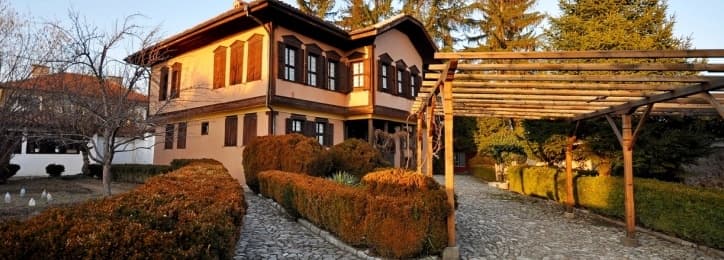
The Tutev House (Tutevata Kashta) is one of the most significant National Revival-era buildings in the town of Panagyurishte and a revered cultural monument of immense historical importance to Bulgaria. Its original owner, Ivan Doychev Tutev, was a respected local craftsman, a wealthy merchant, and a passionate revolutionary who took an active part in the organization of the legendary April Uprising of 1876. This historic home is deeply embedded in the national memory as the final headquarters of the prominent revolutionary leader Georgi Benkovski within the town.
It was inside the Tutev House where, following the arrival of a swift courier carrying the famous Bloody Letter from Todor Kableshkov announcing that Koprivshtitsa had already risen, the revolutionary leaders made the ultimate decision to launch the uprising in Panagyurishte. From the doorstep of this very house, the four great apostles of the 4th Revolutionary District emerged: Georgi Benkovski, Panayot Volov, Zahari Stoyanov, and Georgi Ikonomov, leading the Bulgarian people in their struggle for national liberation.
The structural history of the residence evolved through several distinct phases:
In 1947, the direct heirs of Ivan Tutev made a patriotic gesture by donating the historic house to the town of Panagyurishte to be converted into a public museum. The first partial preservation of the building took place in the 1950s. A second reinforcement project was carried out between 1975 and 1976 under the professional guidance of architect Petar Dikidzhiev.
The most extensive structural restoration of the museum complex was successfully completed between 1988 and 1991. This major project was led by architect Kirilka Geneva, while the invaluable National Revival frescoes inside the rooms were meticulously and authentically restored by the expert conservator Zdzislaw Karczewski. Today, the Tutev House museum welcomes thousands of domestic and international travelers, immersing them in the historic atmosphere of the fateful April days of 1876.
Tuteva house-museum is located in Pazardzhik, Bulgaria.
Tuteva house-museum is most easily reached by car. Use the coordinates above to navigate, or open the location in OpenStreetMap or your preferred maps app for turn-by-turn directions. Public transport options vary by region — for remote destinations a rental car gives the most flexibility.
Tuteva house-museum can be visited year-round. Verify current opening hours directly with the museum before your visit, as schedules change seasonally and on public holidays.
Opening hours and admission fees vary, and most Bulgarian museums close one day per week (commonly Monday). Verify current schedules and prices directly with the museum or the local tourist information office before visiting Tuteva house-museum, especially on public holidays.