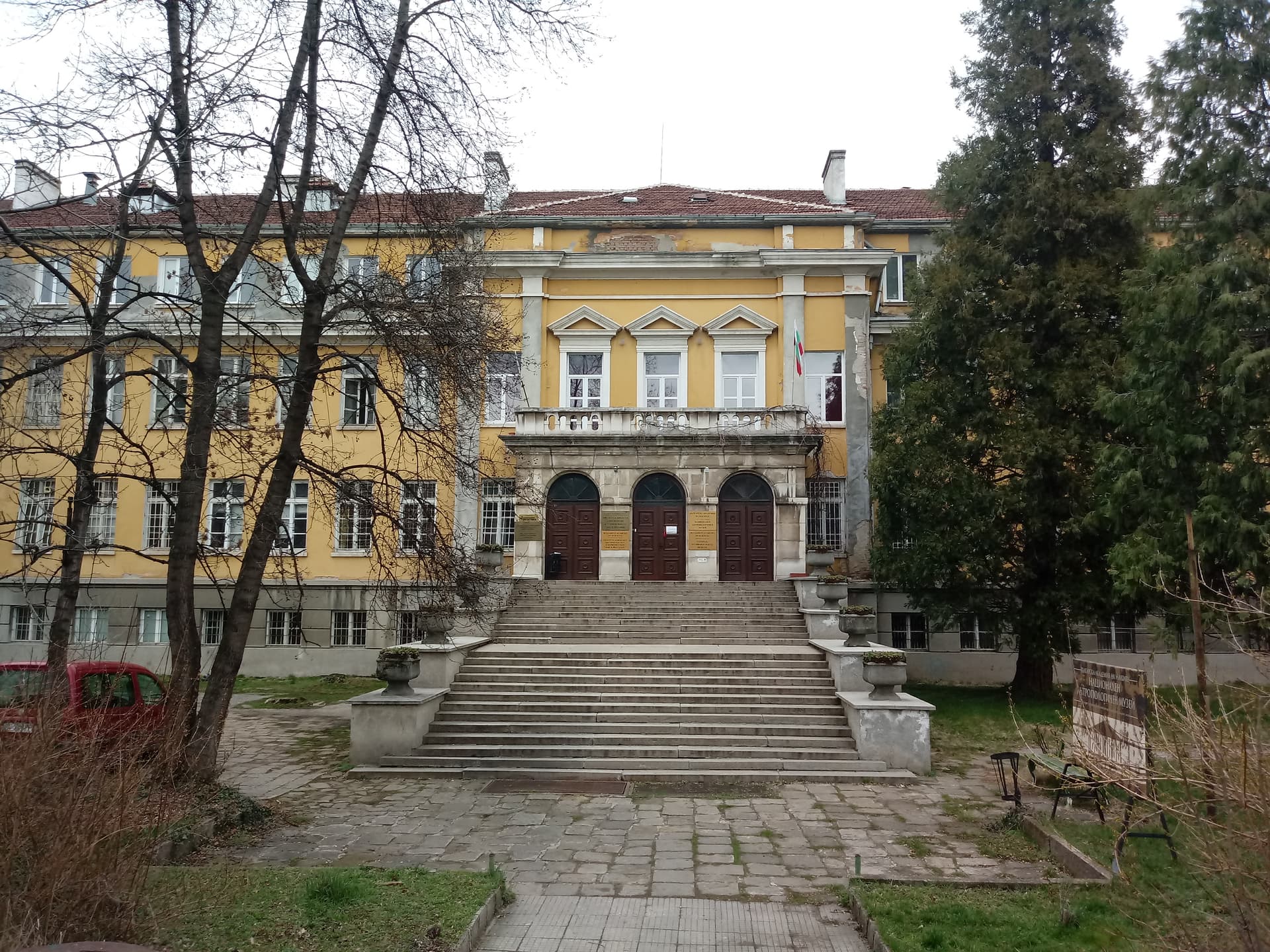
The Museum of Paleontology and Historical Geology is under the dome of the north wing of Sofia University, 15 Tsar Osvoboditel Boulevard, on the fifth floor. It is run by the Department of Geology, Paleontology and Fossil Fuels and holds more than 200,000 fossils, rock samples and maps from Bulgaria and neighbouring lands.
The star exhibit is the skeleton of a deinothere (Deinotherium thraciensis), an elephant relative with downward-curving tusks. It is more than 90% original, almost 7 m long and 4.2 m tall, and is considered the best-preserved such skeleton in the world. The animal lived about 10 million years ago. It was found in 1965 near the village of Ezerovo, outside Plovdiv, by the biology teacher Dimitar Kovachev and his pupils, and restored over seven years by Ivan Nikolov.
The central foyer shows vertebrate fossils, almost all mammals: tusks, jaws, skull parts and teeth of mammoths, mastodons, anancus and zygolophodon, and parts of ancient rhinoceros skeletons. The museum also keeps holotypes — specimens of species new to science first described by Bulgarian palaeontologists.
The collection was started in the late 19th century by the geologist Prof. Georgi Zlatarski. In the early 20th century the university bought major collections — the Krantz, the Alexander, and Czech and Swiss collections. The museum took its present form in 1965.
The museum opens on weekdays only, Monday to Friday, with a lunch break; check the department’s website for times.
Accessibility: the museum is on the fifth floor of the university building.
With children: the deinothere skeleton impresses children too, and the visit is short — two rooms.
Museum of Paleontology and Historical Geology is located in Sofia City, Bulgaria.
Museum of Paleontology and Historical Geology is most easily reached by car. Use the coordinates above to navigate, or open the location in OpenStreetMap or your preferred maps app for turn-by-turn directions. Public transport options vary by region — for remote destinations a rental car gives the most flexibility.
Museum of Paleontology and Historical Geology can be visited year-round. Verify current opening hours directly with the museum before your visit, as schedules change seasonally and on public holidays.
Opening hours and admission fees vary, and most Bulgarian museums close one day per week (commonly Monday). Verify current schedules and prices directly with the museum or the local tourist information office before visiting Museum of Paleontology and Historical Geology, especially on public holidays.